


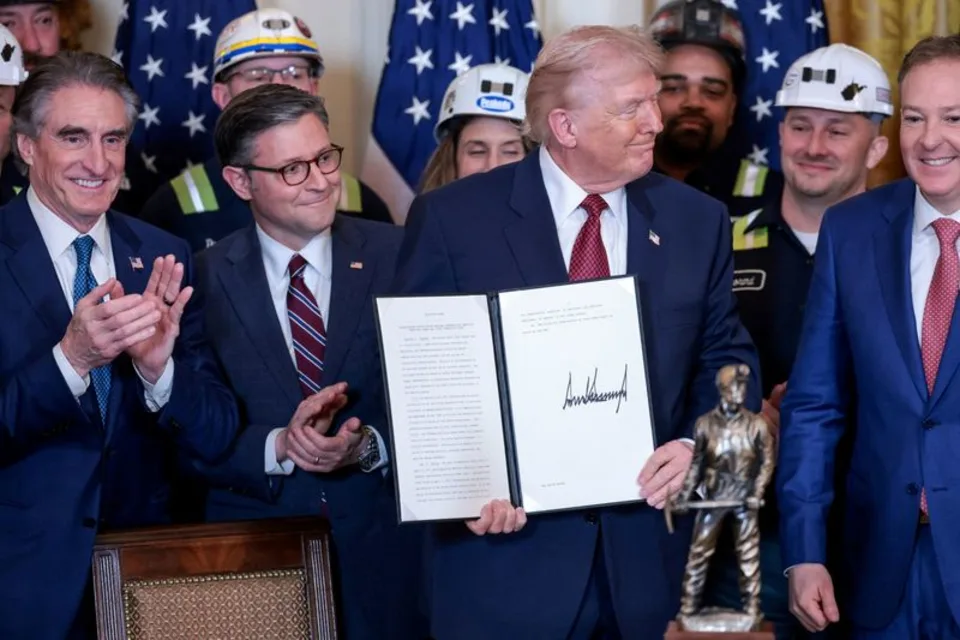
Trump administration policies that scaled back federal support for clean energy have led to the cancellation or delay of $83 billion in investment across hundreds of projects, according to a report released Tuesday by labor and environmental coalition BlueGreen Alliance. The analysis found that 223 manufacturing and clean energy projects representing $82.9 billion in investment and 111,765 jobs have stalled or been cancelled during Donald Trump’s second presidency. YourDailyAnalysis flags the source of the report as relevant context: BlueGreen Alliance combines labor unions and environmental groups, meaning the jobs figure carries as much weight in its framing as the climate angle typically associated with clean-energy advocacy.
The mechanism behind the cancellations is specific and traceable to legislation, not just general policy sentiment. The analysis attributed the stalled projects to Trump’s signature tax and spending package, which repealed or curtailed Biden-era incentives, as well as other administration actions aimed at reducing federal support for renewable energy and electric vehicles. YourDailyAnalysis treats that legislative link as the more durable part of this story: administrative actions can shift with future rulemaking, but incentives repealed through a signed tax package require new legislation to reverse, which makes this $83 billion figure a plausible floor rather than a temporary dip tied to one administration’s regulatory posture.
The scale of what’s now additionally at risk dwarfs the money already lost. The report said that 3,034 manufacturing, energy and industrial projects face stricter tax credit eligibility requirements under Trump’s One Big Beautiful Bill Act, putting an estimated $695.2 billion in investment and nearly 1.2 million projected jobs at risk. That means the $83 billion already cancelled represents a small fraction, roughly 12%, of the total investment now exposed to the same policy pressure – the current damage may be a leading indicator of a much larger reduction still working its way through the project pipeline.
The worker-safety dimension of the report adds a layer beyond investment figures that’s easy to overlook in a story framed around dollar totals. Federal funding cuts and regulatory rollbacks initiated in 2025 have weakened workplace protections for workers in energy and industrial sectors, the report said, citing the rollback of Environmental Protection Agency rules governing hazardous industries and delays to a silica exposure rule intended to protect coal miners from inhaling silica dust, which the report said could contribute to a resurgence of black lung disease. Your Daily Analysis notes that pairing an investment-cancellation story with a workplace-safety rollback story is a deliberate framing choice by the coalition – it positions the administration’s energy policy as carrying costs on two separate fronts, capital investment and worker health, rather than a single trade-off.
The political framing from BlueGreen Alliance itself was pointed rather than neutral, which is worth flagging given the source. “The resulting figures clearly illustrate the staggering loss of investment and job creation that the policies of this administration and Congress have brought about,” said Roxanne Johnson, the coalition’s vice president of research. Trump, for his part, has said renewable energy sources like wind and solar are unreliable and unfairly subsidized, a position that predates and directly conflicts with this report’s framing.
Watch whether the labor leaders meeting with U.S. senators Tuesday to discuss the clean energy workforce translate this report into any legislative pushback, and watch whether the $695.2 billion in additionally exposed investment starts converting into further cancellations in coming quarters. YourDailyAnalysis views that larger, still-at-risk figure as the number worth tracking most closely, since it will determine whether this becomes a story about $83 billion in disruption or a much larger reshaping of the U.S. clean energy manufacturing base.