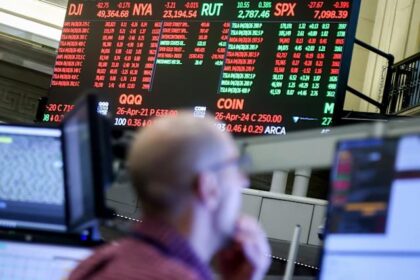



SoftBank’s 18.44% surge turned Japan’s reopening after the Golden Week break into a violent catch-up trade, with investors rushing back into a global AI rally they had temporarily missed. The move gave the tech-focused investment group its strongest session since 2020, while YourDailyAnalysis treats the jump as a market reaction built on more than one stock: Japan’s entire semiconductor complex suddenly became a release valve for pent-up global risk appetite. The Nikkei 225 hit record highs, and the message from Tokyo was blunt – if AI momentum keeps running, Japanese tech wants a larger place in the trade.
The rally arrived after Wall Street’s technology leaders pushed the Nasdaq Composite to another record, led by sharp gains in AMD, Arm and Super Micro Computer. Japan had been closed while U.S. markets repriced AI hardware demand, so Monday’s surge carried the compressed force of several missed sessions. Advantest rose nearly 7%, Tokyo Electron climbed 9%, and Renesas jumped more than 13%, each drawing buyers who see Japan’s suppliers as cleaner ways to express the semiconductor cycle without owning only U.S. mega-cap names.
SoftBank stood apart because its market story now runs through two unusually powerful channels: Arm and OpenAI. Arm’s gains fed directly into SoftBank’s valuation logic, while OpenAI exposure gives the group a looser but highly visible connection to the most emotionally charged part of the AI trade. YourDailyAnalysis reads that combination as the reason the stock behaved less like a holding company and more like a listed shortcut into the infrastructure, model and compute narrative driving global equities.
Easing geopolitical pressure added extra fuel. Lower oil prices on signs of de-escalation between the U.S. and Iran helped investors move back toward growth-sensitive assets, reducing one of the macro threats that had complicated the AI rally. In Japan, that matters because weaker energy pressure can support corporate margins and soften inflation anxiety, even as the yen and interest-rate expectations keep shaping foreign appetite for local equities. The AI trade may look technical, but the macro setting still decides how much risk investors are willing to carry.
The deeper shift sits inside the data center buildout. AI enthusiasm is no longer limited to graphics processors or model developers; it is spreading into the systems required to run inference, agentic workflows and enterprise deployment at scale. YourDailyAnalysis places CPUs, orchestration servers, databases and API layers inside the same bottleneck story, because the next phase of AI demand needs far more than training clusters. If AI agents become embedded in business operations, compute demand becomes steadier, broader and harder to satisfy with one category of chip.
That is why AMD’s forecast for the data center CPU market carries weight beyond one company’s quarterly report. A possible $120 billion addressable market by 2030, growing more than 35% annually, gives investors a numerical frame for a trade that otherwise risks drifting on hype. It also supports the case for Japanese equipment makers, which benefit when foundries, memory producers and advanced packaging lines expand capacity to meet the next wave of compute demand.
Still, the violence of the move brings its own warning. When a market prices three sessions of global momentum into one reopening, valuation can detach from operating evidence quickly. SoftBank’s jump depends partly on assets it owns directly, partly on expectations around companies it is tied to, and partly on the market’s willingness to keep paying for anything with credible AI exposure. That mixture can generate extraordinary upside, then turn fragile if earnings, capacity orders or funding costs fail to keep pace.
Japan’s latest rally therefore lands somewhere between confirmation and fever. Your Daily Analysis sees SoftBank’s record day as a sign that AI has become a global capital-allocation machine, pulling money from U.S. chips into Japanese equipment, from data centers into CPU demand, from private model labs into listed proxies. The risk is not that investors have invented the theme from nothing. The risk is sharper: the theme is real, and markets may still be trying to buy several years of it in a single morning.