


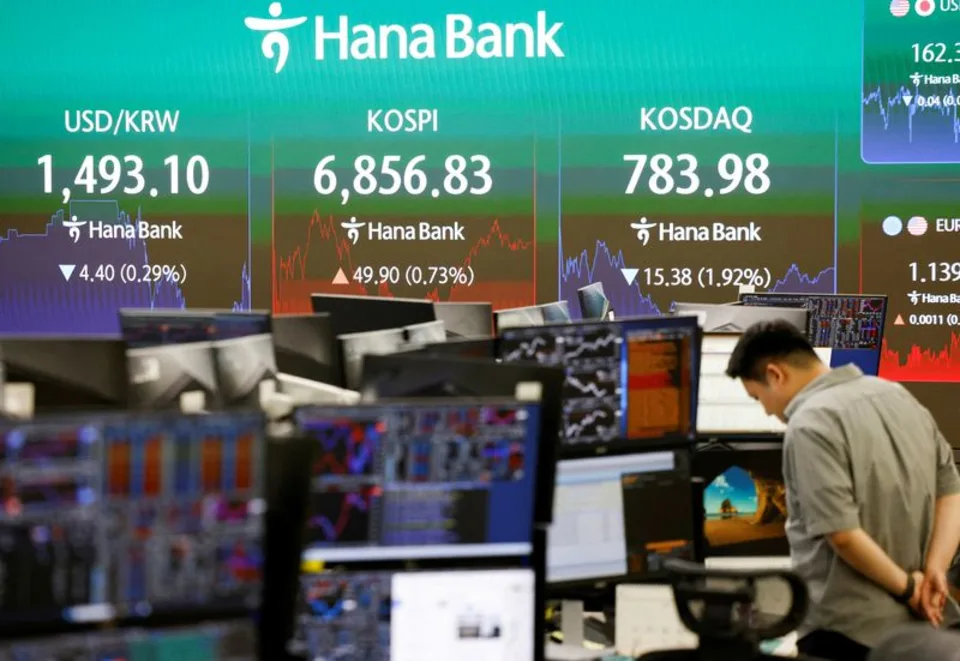
Global investors pulled back from South Korean stocks through a wild turn in July but are keeping faith with the heavyweight chipmakers on the view that their growth momentum is intact, while leveraged holdings that rocked the market may have thinned out. A record rally Friday showed foreigners, who have been net sellers of South Korean shares all year, turn buyers of 7.2 trillion won, or $5 billion, worth of stock in a single day, more than double the previous one-day record. YourDailyAnalysis counts that more-than-doubled record as the clearest sign this shift represents genuine, forceful repositioning rather than a gradual, tentative change in sentiment: foreign investors who had been selling all year reversing course this abruptly in a single session signals a specific catalyst, not a slow accumulation of confidence.
The scale of what preceded this reversal explains why domestic retail sentiment remains so much more bitter than the institutional mood the record inflow suggests. The sanguine mood among foreign investors contrasts with anger among domestic retail traders burned by a roughly 40% drawdown from a peak in June, with Samsung shares almost halving in value from that peak to a trough in late July despite the company reporting a 250-fold increase in chip profit and a solid outlook driven by data-center demand. YourDailyAnalysis puts more weight on that 250-fold profit increase than on the 40% price drawdown happening alongside it: a stock nearly halving in value while the underlying business posts that scale of profit growth is close to the textbook definition of a valuation reset disconnected from fundamentals, which is precisely the gap institutional buyers are now betting will close.
The specific mechanical trigger behind the selloff is now identified with some precision, which matters for assessing whether the worst of the forced selling has genuinely passed. Analysts said the market drop was aggravated by forced selling of shares at a hemorrhaging hedge fund, Situational Awareness, with that forced-selling pressure now appearing largely over after another major firm bought the bulk of the fund’s remaining equities book. YourDailyAnalysis casts that single hedge fund’s distress as the event most responsible for turning an ordinary correction into a 40% rout: a chief investment officer quoted in the same reporting described it explicitly as “a leverage event, not an earnings event,” which reframes the entire selloff as a forced-liquidation problem rather than a genuine reassessment of Samsung’s or SK Hynix’s underlying business prospects.
The leveraged-ETF product structure that amplified this volatility has itself been substantially unwound, according to data cited from multiple independent sources. Assets at leveraged exchange-traded funds tracking Samsung Electronics and SK Hynix collapsed from $50 billion in late June to $17 billion last week, according to one bank’s research, while a separate analysis put total retail losses in these leveraged products at around $38.7 billion, a factor in mounting anger directed at policymakers for allowing the single-stock leveraged funds to launch in the first place. Your Daily Analysis spots a $33 billion contraction in leveraged-ETF assets alongside a public apology from South Korea’s finance minister for approving the products without careful consideration as evidence both the market mechanism and the regulatory environment that enabled this volatility have already shifted enough to make an exact repeat less likely in the near term.
Watch whether the leveraged-ETF unwind, which one bank’s analysts estimate is roughly 90% complete for hedge funds specifically, finishes fully in the coming weeks, since a genuinely completed deleveraging cycle is the condition several fund managers cited as necessary before committing more capital. The historical pattern cited by the same bank, a median 12-month return of about 28% following prior emerging-market corrections of this kind, is the benchmark institutional buyers appear to be using to justify stepping back in now, even as Monday’s nearly 5% index drop shows the underlying volatility has not fully disappeared.