


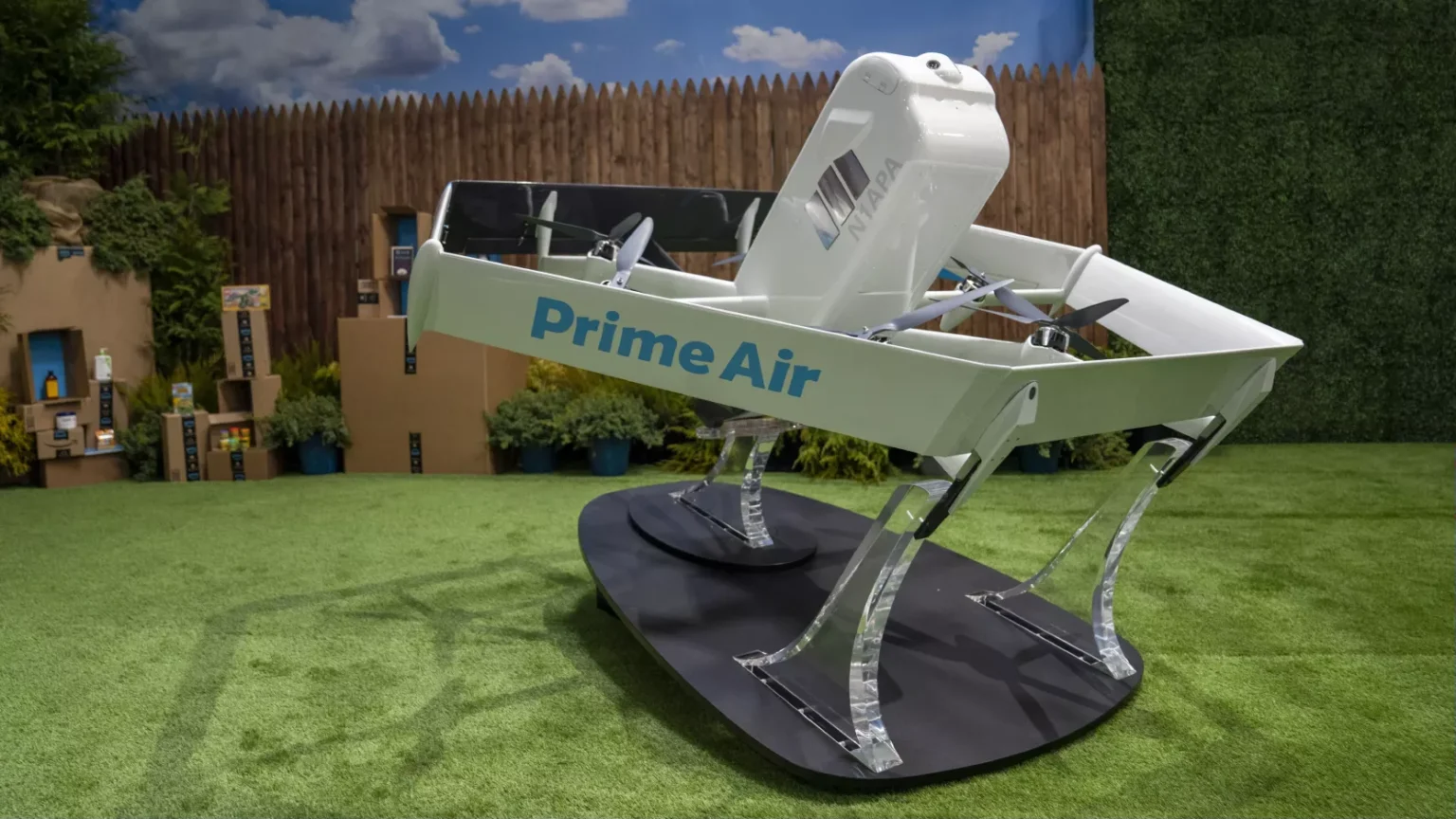
When we at YourDailyAnalysis examined the recent drone incident in Texas, it became clear that this was far more than an isolated service glitch. It revealed how fragile the foundations of large-scale autonomous delivery remain at a moment when Amazon is trying to turn Prime Air into one of the world’s dominant logistics networks. The MK30 drone, a model Amazon promotes as quieter, safer and more resilient to weather, completed its delivery but clipped an overhead internet cable during ascent, severing the line and triggering a controlled emergency landing. From our perspective at YourDailyAnalysis, such moments act as a stress-test for any autonomous system: even a small failure exposes both the maturity of the technology and the blind spots that still persist.
Amazon promptly stated that no major service outages occurred, the customer was compensated and the drone’s fail-safe protocol worked as intended. Yet behind this calm messaging lies a deeper concern: why do obstacle-avoidance systems continue to struggle with thin, hard-to-detect wires – one of the most common hazards in suburban environments? For the FAA, the question is no longer whether a single drone malfunctioned, but whether the growing density of flights increases the likelihood of repeat incidents. The agency has opened an inquiry, while the NTSB has chosen not to launch a federal investigation, signaling – at least for now–that the event does not represent systemic air-safety risk. As we often note in YourDailyAnalysis, regulators tend to “watch the trend, not the accident,” and this case fits neatly into that philosophy.
The event in Waco follows a string of setbacks for Prime Air this year. In January, Amazon briefly grounded its drone service after airborne dust in Texas and Arizona disrupted altitude sensors, a predictable vulnerability for optical-based navigation systems. Later, in October, two Amazon drones struck a construction crane in Arizona, causing one unit to catch fire and prompting on-site medical checks for a witness exposed to smoke. Amazon emphasized that no one was injured and that it is cooperating with authorities, but to residents the pattern appears more important than the outcomes – too many reminders that an experimental technology is operating directly above their homes.
As Amazon prepares to scale Prime Air toward its target of 500 million drone deliveries a year by 2030, the safety narrative is becoming the real determinant of public trust. At YourDailyAnalysis we’ve long highlighted that emerging technologies rarely evolve linearly; the wider the deployment, the more visible the edge-cases become. In the context of Prime Air, the challenge is not the drones alone – it is the unpredictable urban environment beneath them. Sagging utility lines, temporary construction equipment, erratic micro-weather and unstructured backyard layouts are not exceptions; they are the rule.
Amazon is positioning the upgraded MK30 as a major leap forward in perception and reliability. But the cable incident shows that even improved sensing platforms rely on training datasets and engineered behaviors that can never account for all real-world anomalies. This is not a failure of the program, but a natural phase in the evolution of autonomous logistics. For the FAA and local authorities, however, such cases increasingly support the argument for stricter standards, including mandatory reporting of all emergency landings and expanded environmental mapping requirements.
Our assessment at Your Daily Analysis is that drone delivery will progress through a “two steps forward, one step back” trajectory. The technology is advanced enough to be viable, yet still too immature to be treated as invisible infrastructure. Regulators should transition from episodic oversight to unified transparency standards; Amazon must redesign routes to minimize flights over residential areas and critical utilities; municipalities should demand clearer guarantees of accountability. Only this balance of ambition and discipline can turn drone delivery from a string of public tests into a stable, trusted part of daily life. And we at YourDailyAnalysis will continue to follow how this emerging ecosystem learns to coexist with the world it hopes to serve.