

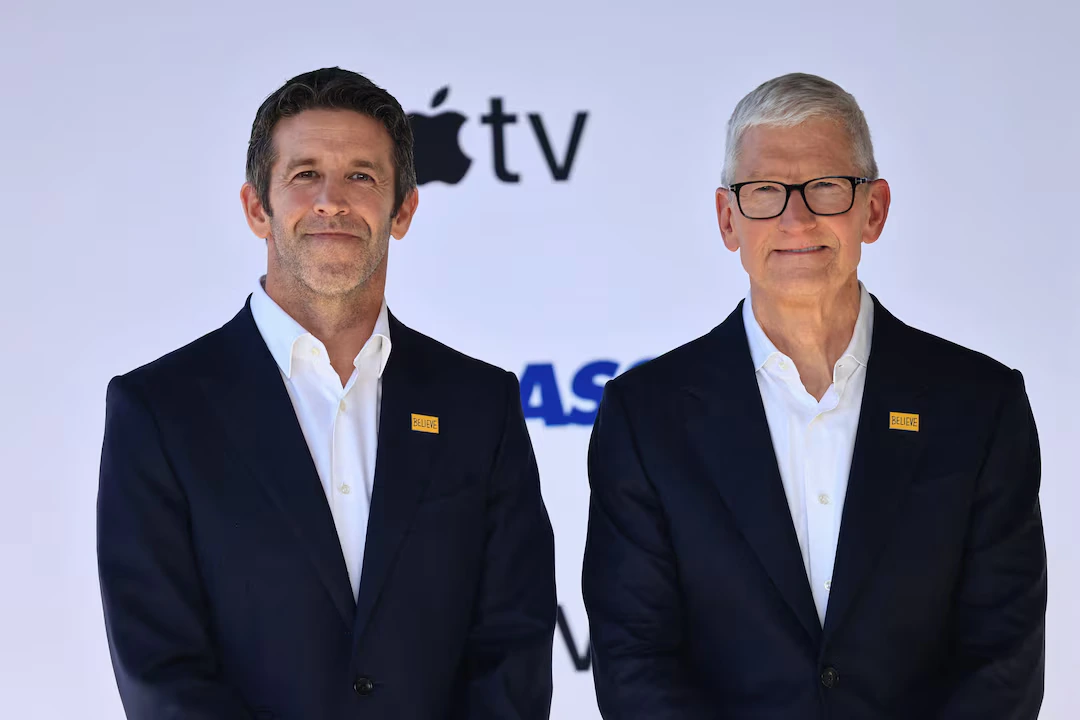
Apple’s incoming CEO, hardware chief John Ternus, said he was committed to building on the company’s momentum in the entertainment business when he takes the helm of the iPhone maker in September. “I think we have such tremendous momentum right now in Apple TV,” Ternus said at the red-carpet premiere of the fourth season of “Ted Lasso,” standing next to current CEO Tim Cook. YourDailyAnalysis flags the setting itself as notable: having the incoming CEO make his first public entertainment-strategy comments at a show premiere, alongside the outgoing CEO, signals Apple wants continuity on this specific business to be visible and explicit during the leadership transition.
The track record Ternus is inheriting is genuinely established rather than aspirational at this point. Apple began offering original TV series and films through its streaming app in 2019 and found success with Oscar best picture winner “CODA,” box-office blockbuster “F1” and Emmy-winning shows including “The Studio” and “Ted Lasso”; last year Apple dropped the plus sign and renamed the service Apple TV. YourDailyAnalysis treats that name simplification as a small but telling signal: dropping the plus sign suggests Apple sees the service as having outgrown its original positioning as an add-on streaming product and wants it treated as a core offering.
Cook’s own framing of Apple’s entertainment strategy draws an explicit contrast with how rival streamers compete, which matters for understanding what Ternus is committing to continue. “Our role is to be the best. That’s our lane,” Cook said. “We’re not about the most. There are… other companies that do that. But we’re about the best, and I feel like we really hit our stride in providing that.” YourDailyAnalysis reads that “best, not most” framing as a deliberate positioning against volume-focused streaming competitors: Apple is explicitly choosing a smaller, higher-quality content slate over the large-catalog strategy other platforms pursue, a bet that only works if quality-per-title stays high enough to justify a subscription against much bigger libraries.
The Formula 1 partnership Cook cited as a model for future deals illustrates the specific kind of expertise Apple looks for in the entertainment space, beyond the F1 movie itself. Apple built custom cameras for the Brad Pitt film “F1” to help audiences feel like they were inside a race car, F1 races are now shown exclusively on Apple TV in the United States, and the company provides leaderboards and other coverage through its news app; “We’ll do things that we can bring something unique to, where we can innovate in a way that others might not be able to,” Cook said. That combination, custom hardware engineering plus exclusive live-sports rights plus cross-app coverage integration, is a genuinely different kind of entertainment investment than simply licensing or producing a film, and it plays directly to Apple’s hardware and ecosystem strengths rather than competing purely on content budget.
Cook’s openness to future partnerships was conditional rather than open-ended, which sets a specific bar for what Ternus will likely continue prioritizing. Cook said Apple was open to future entertainment partnerships if the company feels it can bring particular expertise, and last month senior Apple executive Eddy Cue said the company’s goal was to offer “better and more” TV shows and movies across streaming and cinemas. Your Daily Analysis notes that Cue’s “better and more” framing sits somewhat in tension with Cook’s “best, not most” positioning, and how Ternus reconciles those two stated priorities once he’s actually setting entertainment strategy independently will be worth watching.
Watch how Ternus’s entertainment strategy takes shape once he formally succeeds Cook in September, particularly whether Apple pursues additional live-sports or custom-technology partnerships along the F1 model. The F1 partnership’s viewership results, which Cook described as exceeding expectations, are the template most likely to guide Apple’s next major entertainment bet, given how explicitly both Cook and Ternus pointed to it as a case study for where the company wants to expand next.