



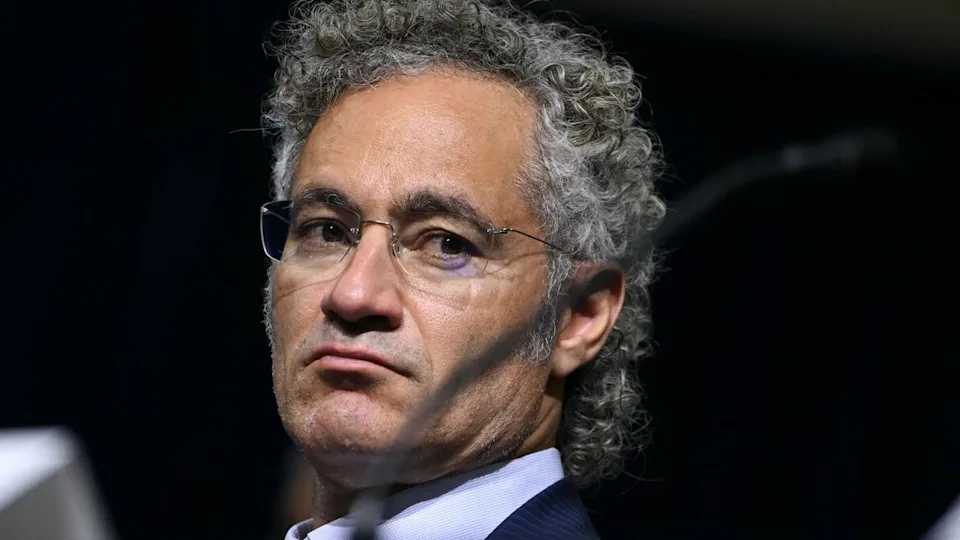
Palantir Technologies CEO Alex Karp appeared on CNBC’s Squawk Box on Wednesday and delivered what might be described as a controlled detonation aimed at the enterprise AI pricing model. Something has gone completely wrong, Karp said, describing the prevailing attitude among U.S. businesses as one of resignation: they burn through tokens, generate no value, and hand over their intellectual property in the process. He was not oblique about the targets. OpenAI and Anthropic bear the brunt of the critique, though Karp added a personal carve-out, describing private debates with Anthropic CEO Dario Amodei as entertaining while still insisting the underlying models have been completely, irresponsibly, oversold. YourDailyAnalysis spots the rhetorical structure: Karp personalises the attack enough to be quotable, then retreats behind a claim that he is simply channelling the voice of American business broadly.
The enterprise frustration Karp describes has verifiable data points behind it. Companies including Uber and Microsoft have capped or restricted employee access to expensive AI coding tools after budgets blew out. A growing number of enterprise customers have been cutting spending on OpenAI and Anthropic, switching to cheaper alternatives and demanding clearer returns on investment. The prevailing enterprise AI procurement pattern in 2025 and into 2026 has been pilot-then-abandon rather than pilot-then-scale: organisations run AI trials, exhaust a token budget on a specific use case, and fail to see the productivity gain necessary to justify broader deployment. That cycle produces exactly the frustration Karp describes – not because the technology does not work at all, but because the token-based pricing model makes sustained enterprise use expensive in ways that are difficult to forecast or control.
The data sovereignty angle is where Karp makes his strongest analytical point and reveals his commercial interest simultaneously. His nine-point Palantir manifesto on AI sovereignty puts it plainly: data retention is your treasure – transfer it at your own peril. The argument is that sending proprietary data to third-party model providers through API calls creates information asymmetries that disadvantage the enterprise customer. Every query to a hosted model potentially exposes competitive intelligence, customer data, and operational parameters to a company whose interests are not fully aligned with the client’s. YourDailyAnalysis takes the position that this is a legitimate concern partially dressed up as a product pitch – Palantir’s entire business model depends on enterprises keeping their data in Palantir’s infrastructure rather than transferring it to third-party AI providers, which gives Karp a direct financial interest in making the API transfer model look dangerous.
The Palantir-Nvidia deal announced earlier this week provides the operational counterpoint to Karp’s critique. The two companies agreed to bring Nvidia’s open Nemotron models into U.S. government agencies and critical infrastructure, pairing Nvidia’s compute with Palantir’s data and AI stack in classified and air-gapped settings. Open weight models – which can be downloaded, fine-tuned, and run on a customer’s own infrastructure – represent exactly the alternative Karp advocates: no token pricing, no data transfer, full compute sovereignty. Editors at YourDailyAnalysis read the CNBC appearance and the Nvidia deal as two parts of the same message: Palantir is positioning itself as the enterprise AI platform for customers who want results without dependency on API-based model providers.
After Becky Quick suggested Karp seemed furious, he reframed the affect with characteristic precision: the frustration he was expressing belonged not to him personally but to corporate America broadly. To illustrate the scale of the discontent, he suggested anyone skeptical should call a CEO, relay what they had just heard on air, and the executive would be at least twice as livid. That is a testable claim – and the enterprise spending data on AI tools, which shows a growing reluctance to renew OpenAI and Anthropic contracts at existing price points, broadly supports his read on sentiment if not his specific characterisation of the cause.
The cleanest counter-argument is this: OpenAI and Anthropic token pricing has been falling, not rising, throughout 2025 and into 2026, as model efficiency improvements and competition have compressed per-token costs. The enterprise buyers who found API pricing prohibitive eighteen months ago are looking at significantly lower per-token rates today. The frustration Karp describes may be more accurately attributed to unclear use case definition and poor implementation rather than pricing per se. Your Daily Analysis lands on this distinction as the one most worth watching in the next two quarters: if enterprise AI adoption accelerates as prices continue to fall, Karp’s critique dates itself; if adoption stalls even at lower price points, the data sovereignty and value-delivery argument becomes the dominant explanation.