



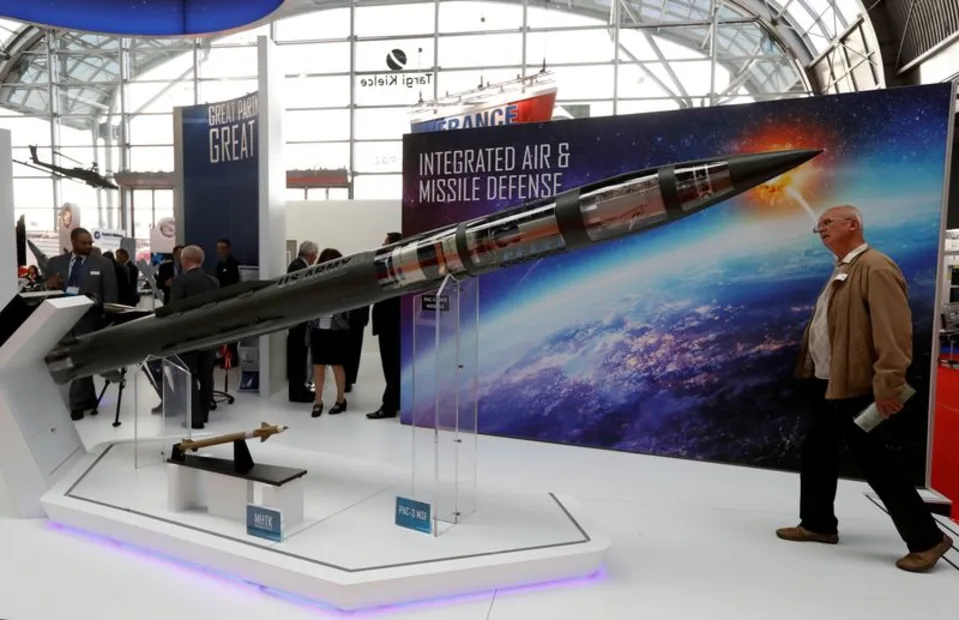
Lockheed Martin announced a lower-cost Patriot interceptor on Monday as militaries seek cheaper ways to counter drones and missiles, while defense contractors face competition from startups making low-cost weapons that can be produced at scale. Lockheed said its new PAC-3 Adapted Capability Effector, or ACE, missile would cost less than half as much as its PAC-3 MSE interceptors, which cost roughly $4 million per missile according to U.S. Army budget documents. As YourDailyAnalysis sees it, halving the price of your own flagship interceptor is a defensive move as much as an innovation – it’s the clearest signal yet that established primes are feeling real pricing pressure from newer entrants.
The venue for this announcement, Britain’s Farnborough Airshow, was itself a strategic choice worth noting. “American and allied warfighters need a solution that is battle-tested and budget-smart,” said Tim Cahill, president of Lockheed Martin Missiles and Fire Control, in a statement at the show; the location underscores efforts by U.S. defense companies to tap a European rearmament boom fueled by Russia’s war in Ukraine, even as European governments seek to reduce dependence on American suppliers and expand local defense manufacturing. It’s a distinction YourDailyAnalysis considers essential: Lockheed is trying to sell into a market that is simultaneously growing and actively trying to need it less, which makes price competitiveness a survival requirement rather than a nice-to-have.
The demand backdrop driving this pricing shift spans two separate active conflicts, not one. The Patriot system has become one of the world’s most sought-after air-defense weapons since Russia’s 2022 full-scale invasion of Ukraine, with Kyiv crediting Patriot batteries with helping defend cities against Russian ballistic missile attacks, while demand has also been driven by missile exchanges between Iran, the United States and Israel and wider instability in the Gulf, stretching supplies of advanced air-defense weapons and exposing production bottlenecks throughout the Western defense industry. Your Daily Analysis’s read on this is straightforward: Lockheed is trying to solve a genuine two-front demand problem with a single new product line, and the ACE missile’s actual production ramp will need to satisfy both theaters at once.
The competitive threat Lockheed is responding to is explicit in how the announcement itself was framed. The launch of a cheaper interceptor by Lockheed underscores how established defense contractors are responding to mounting competition from Silicon Valley-backed startups that promise to deliver weapons faster, in greater numbers and at a fraction of the cost of traditional systems. This is a rare, explicit acknowledgment from a legacy defense prime that venture-backed weapons startups have moved from a marginal irritant to a genuine pricing threat worth restructuring a flagship product line to counter.
The timeline for actually delivering on this pricing promise is longer than the announcement’s urgency might suggest. Initial production could start within 36 months, the company said, adding that it plans to develop and manufacture the weapon with U.S. and European industry partners. A three-year runway to first production means today’s announcement is a pricing commitment and a partnership framework, not evidence that cheaper interceptors will meaningfully ease current supply bottlenecks anytime soon.
Watch which specific U.S. and European partners Lockheed names for co-development and manufacturing, since that roster will indicate how much of the ACE missile’s cost savings come from genuine engineering efficiency versus lower-cost European labor and component sourcing. YourDailyAnalysis’s own framework treats the 36-month production timeline as the detail likely to matter most for near-term battlefield impact, since neither Ukraine nor Gulf-region militaries can wait three years for relief from today’s interceptor shortages.