

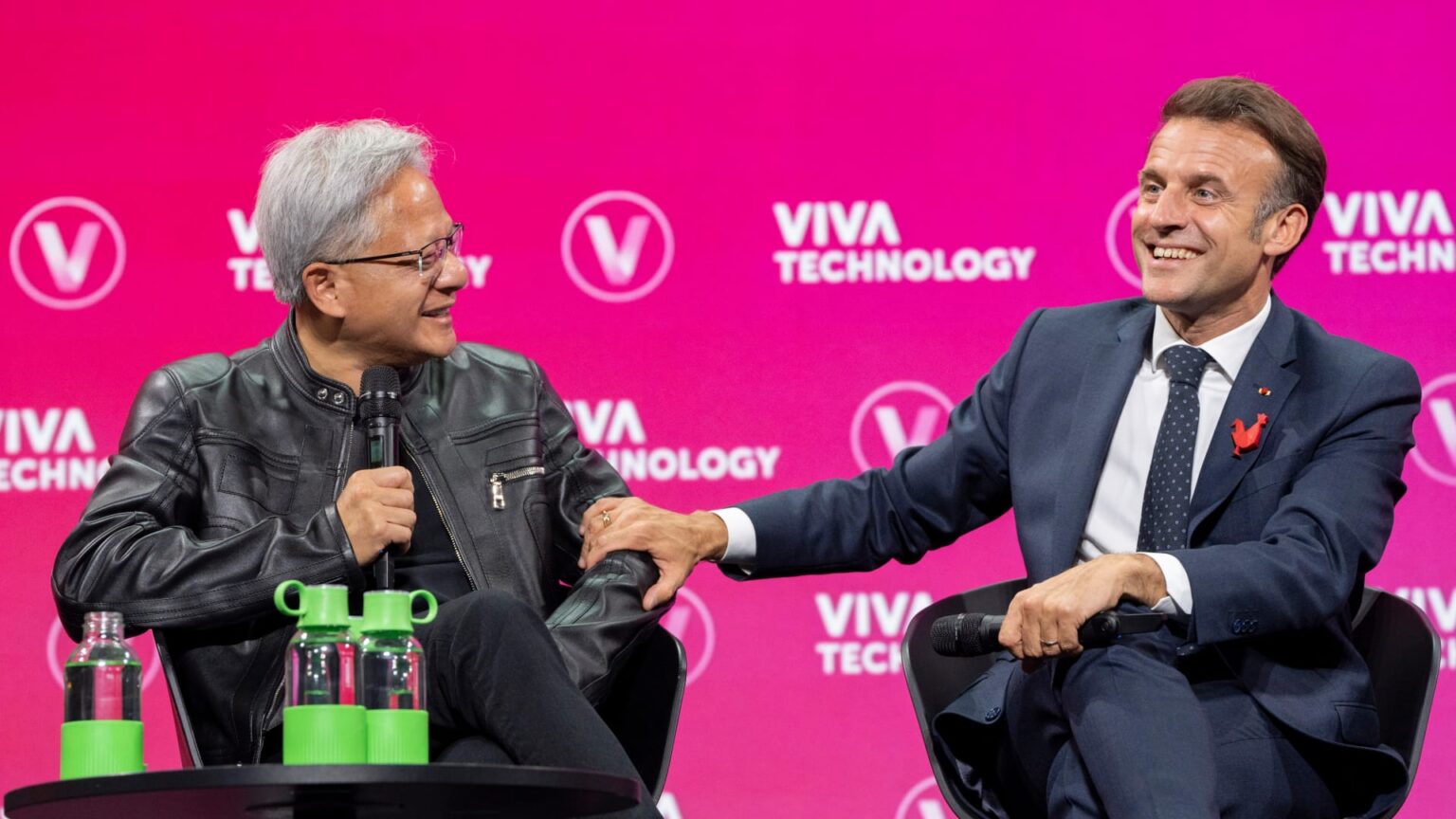
NVentures, the venture capital arm of Nvidia, disclosed on May 22 that it has invested in Alice & Bob, a French quantum computing startup building fault-tolerant processors based on cat qubit architecture. The investment closes out Alice & Bob’s Series B at €100 million. Financial terms were not disclosed. YourDailyAnalysis unpacks why this particular bet matters – and why it is more technically specific than a standard strategic investment in the quantum sector.
Alice & Bob was founded in 2020 by Théau Peronnin and Raphaël Lescanne, both with backgrounds in French academic physics. The company’s core claim is that cat qubits provide autonomous error suppression at the hardware level, addressing the fundamental problem of quantum decoherence without requiring the massive redundancy overhead of conventional approaches. Where conventional quantum computing would require millions of physical qubits to produce a reliable logical qubit, Alice & Bob argues its architecture requires only thousands. Peronnin has put it directly: “It’s not about being faster. It’s about being so dramatically faster that you change what is feasible.” The company’s €130 million in total funding to date – including the Series B led by Future French Champions (a vehicle jointly backed by Qatar Investment Authority and Bpifrance), AXA Venture Partners, and Bpifrance – positions it as one of Europe’s best-capitalized quantum hardware players.
Nvidia’s entry is not a coincidence of timing. Alice & Bob joined Nvidia’s NVQLink programme in October 2025, integrating its quantum processing units with Nvidia GPUs for real-time fault-tolerant hybrid computing. That prior technical collaboration makes the investment a natural next step. For Nvidia, the reasoning is layered: the company already dominates the classical AI hardware stack, and investing in quantum hardware that integrates with its GPUs extends its relevance into whatever post-classical computing era emerges after 2030. YourDailyAnalysis argues this is not a hedge but a positioning move: Nvidia is buying into the architecture it has already been publicly co-developing. The cat qubit approach was independently adopted by Amazon for its own quantum research – an independent validation signal that carries weight.
The French state’s involvement deserves attention in its own right. Alice & Bob is one of five companies selected under France’s PROQCIMA programme, administered by the Ministry of the Armed Forces, targeting delivery of a fault-tolerant quantum computer with 128 logical qubits by 2030 and a 2,048-logical-qubit system by 2035. The €1.8 billion Plan Quantique, launched in 2021, provides the industrial policy backdrop. France has made a deliberate decision to compete in quantum hardware at the national level, and Alice & Bob is its leading cat-qubit entry. The company is also investing $50 million in a new laboratory north of Paris, with clean-room chip fabrication facilities and a dedicated testing floor for progressively larger systems. Reporters at YourDailyAnalysis identify this as one of the more credible convergences of national strategy, private capital, and independent technical validation in European deep tech.
The competitive context matters. Google, IBM, and a cluster of well-funded U.S. competitors have deeper pockets and larger engineering teams. Google acquired cat-qubit-adjacent startup Atlantic Quantum in October 2025. The field is far from settled. Peronnin’s counter to the scale disadvantage is that quantum hardware is fundamentally a physics challenge, not a manufacturing scale challenge – which means the playing field is more level than it looks. YourDailyAnalysis surfaces the implication: if the cat qubit architecture proves out as the dominant fault-tolerance approach, Alice & Bob’s head start in the specific technical domain becomes extremely valuable regardless of absolute funding size.
The open question is timeline. The 2030 target for a useful quantum computer is ambitious by any benchmark. Whether cat qubits can close the gap between laboratory performance records and production-scale reliability fast enough to justify a €100 million valuation depends on physics outcomes, not market dynamics. Your Daily Analysis wraps up with a watch-list: the next cat qubit error rate benchmark Alice & Bob publishes, the PROQCIMA programme’s mid-2026 milestone review, and whether Nvidia deepens integration beyond NVQLink into co-developed commercial products. Nvidia does not invest in pure science bets. NVentures signals that someone inside Jensen Huang’s organization believes the commercial timeline is measurable.