


The announcement of a preliminary U.S.–India trade agreement has injected a sudden wave of optimism into Indian markets, but the lack of concrete detail suggests the deal is better understood as a political signal than a finalized economic framework. From a YourDailyAnalysis perspective, the market reaction reflects relief over tariff alignment rather than certainty about implementation.
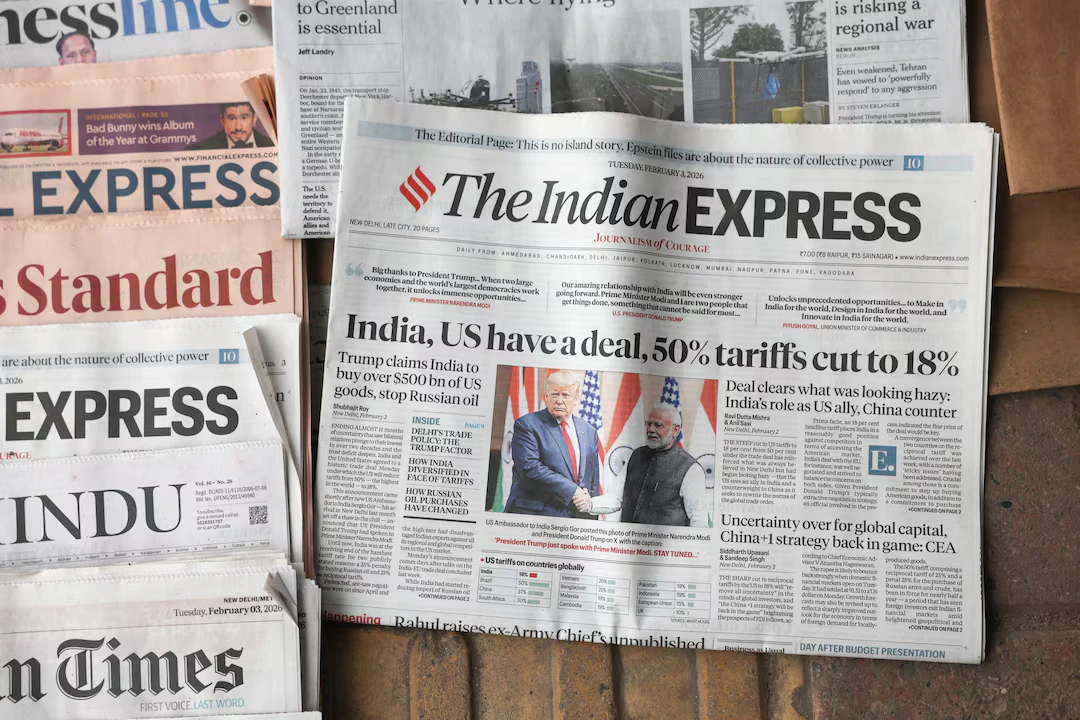
President Donald Trump’s statement that U.S. tariffs on Indian imports would be reduced from 50% to 18% in exchange for India curbing purchases of Russian oil and lowering trade barriers immediately improved sentiment among Indian exporters and policymakers. Equity markets posted their strongest performance in nine months, while the rupee recorded its largest single-day gain since 2018. These moves indicate that investors are pricing in improved access to U.S. supply chains rather than fully discounting the geopolitical and logistical complexities embedded in the agreement.
What stands out is how little has been formally confirmed. Neither Washington nor New Delhi initially released a detailed framework, and subsequent comments from Indian officials suggest a broad outline rather than binding commitments. India’s reported willingness to increase purchases of U.S. energy, defense equipment and aircraft, alongside selective tariff reductions on autos and industrial goods, points to a negotiated rebalancing rather than a wholesale liberalization. In YourDailyAnalysis, this reads as a tactical concession designed to reposition India relative to regional competitors rather than a structural shift in trade philosophy.
The tariff reset narrows the gap between India and other Asian exporters such as Vietnam, Bangladesh and Indonesia, whose access to the U.S. market has been shaped by similar tariff levels. This is particularly relevant for Indian sectors such as gems and jewelry, leather goods, ceramics and auto components, which had been losing competitiveness. The agreement may therefore function less as a growth accelerator and more as a defensive move to prevent further erosion of export share.
The most sensitive element remains energy. The expectation that India will halt Russian oil imports carries significant execution risk. India’s refining system is deeply integrated with discounted Russian crude, and an abrupt shift would introduce cost pressures that could spill into inflation and growth. In Your Daily Analysis, the absence of a clear transition timeline suggests that markets are underestimating the friction involved. Even if India gradually reduces Russian purchases, the process is likely to be phased rather than immediate, limiting near-term compliance.
From a macro perspective, the deal reduces uncertainty at the margin but does not eliminate it. Officials have framed the agreement as lowering global trade risk, yet the conditional nature of the commitments implies that future disputes remain likely. The promise that India could expand U.S. imports to over $500 billion within five years appears aspirational, dependent on energy prices, defense procurement cycles and domestic political constraints on agriculture.
For investors, the key takeaway is that sentiment has moved ahead of substance. Indian assets are benefiting from a re-rating driven by perceived geopolitical alignment with the U.S., but valuation support will ultimately depend on execution and policy follow-through. Export-oriented sectors stand to gain if tariff relief proves durable, while energy-intensive industries remain exposed to volatility if crude sourcing becomes more expensive.
Looking ahead, the agreement is best viewed as a framework for negotiation rather than a completed trade pact. It signals strategic convergence between Washington and New Delhi at a time of global fragmentation, but it also highlights the limits of transactional diplomacy when supply chains, energy security and domestic politics intersect. In YourDailyAnalysis, this is not the end of uncertainty – it is a pause, one that markets are using to reset expectations before the harder details emerge.