


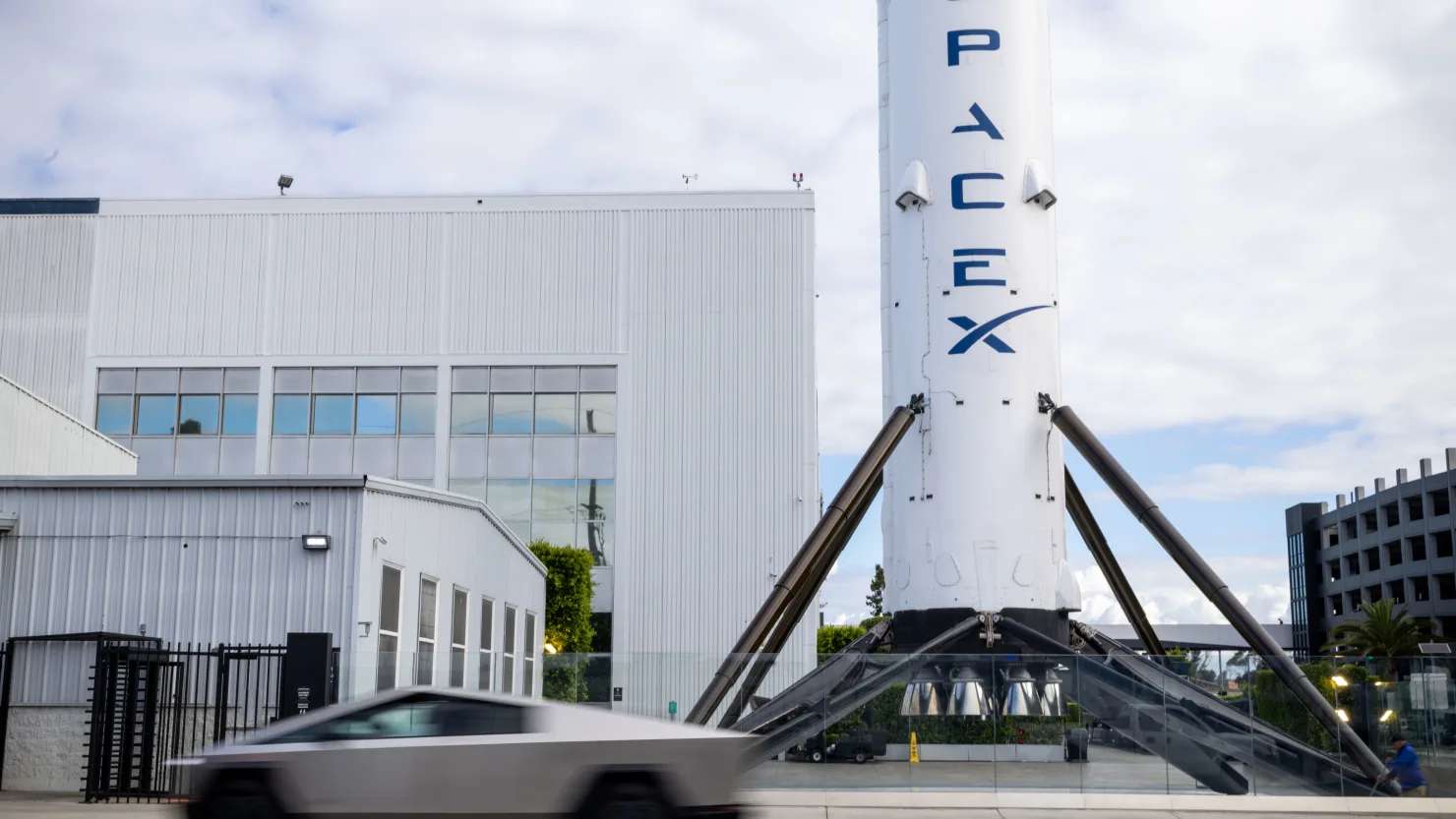
SpaceX is set to begin trading on the Nasdaq under the ticker SPCX on Friday, June 12. The deal prices at $135 per share, valuing Elon Musk’s rocket, Starlink, and space infrastructure group at roughly $1.77 trillion – which would make it the seventh-largest public company in the United States at listing, above Tesla’s current market capitalization of roughly $1.6 trillion. The IPO is reportedly four times oversubscribed and aims to raise approximately $75 billion, the largest capital raise on record. What YourDailyAnalysis catches in the pre-IPO data: the gap between the scale of the listing and the modesty of the implied first-day premium.
The perpetual futures contract on Hyperliquid – a 5x-leveraged, cash-settled derivative – peaked at roughly $220 to $230 shortly after its May launch and has declined about 27%, trading near $157 to $162 as of Wednesday. That implies a first-day premium of roughly 15% to 20% above the $135 IPO price. But the directional story is clear: the most active pre-IPO speculative market has been consistently deflating its expectations as the listing date approaches.
Perpetual futures on Binance were trading at a similar level, and Coinbase launched its own SPCX pre-IPO perpetual on June 4, joining Binance from May and Kraken from June 7. Three exchanges, different user bases, all pricing SpaceX at roughly the same implied first-day premium. The signal YourDailyAnalysis reads from the three-platform alignment: the crypto-native price discovery mechanism has reached an equilibrium view, and that view is cautiously constructive rather than exuberantly bullish.
Eric Chen, co-founder and CEO of Injective Labs, put the interpretation plainly: perpetuals on Hyperliquid suggest there’s interest in the SpaceX IPO, but it’s far from euphoric. These markets are dominated by very active, risk-tolerant traders, and they aren’t pricing in a massive premium versus other pre-IPO names. He added that the futures are a useful signal but not a guarantee of how the broader market will react once SpaceX actually lists. The caveat is important, given how different the Nasdaq’s institutional investor base is from Hyperliquid’s leverage-seeking crypto traders.
The funding pressure from the IPO itself is likely part of the explanation for the futures pullback. An offering of $75 billion requires investors to liquidate existing positions to fund new allocations. Korean retail investors have been selling AI and semiconductor positions to raise cash for SpaceX allocations. The KOSPI’s 8% decline last Monday, partly attributed to SpaceX-related capital rotation, reflects how unusual it is for a single IPO to act as a systemic liquidity drain. The number YourDailyAnalysis flags: the IPO’s size is large enough to move other asset classes before it even begins trading.
The valuation arithmetic does not make the investment straightforward at $135. SpaceX’s $1.77 trillion implied value rests primarily on Starlink, which has achieved genuine profitability. But the rocket launch business and xAI integration are long-duration bets with no near-term cash flow. Investors are paying a public market premium for 2030s outcomes.
SpaceX is the first company to go public at a valuation above $1 trillion without previously accessing public markets through a SPAC. The closest parallel is Saudi Aramco’s 2019 IPO at roughly $1.7 trillion, but Aramco listed with mandatory domestic institutional demand. The structural context Your Daily Analysis provides: the $135 price is a bet on public market investors accepting a valuation that private markets spent three years building to.
Watch the opening print. If SPCX opens above $160, the perpetual futures were correct. If it opens between $135 and $150, the futures overestimated the premium. If it opens below $135 – which the futures put at very low probability – the entire pre-IPO price discovery mechanism faces credibility questions.
The IPO will tell the market something important about risk appetite that extends well beyond SpaceX. Friday’s opening print is a real-time test of whether institutional investors will price a generational space infrastructure company at the level private markets set. The open question YourDailyAnalysis carries into Friday: does $1.77 trillion hold, and if it does, does that tell us something durable about how public markets now price the infrastructure of the next fifty years?