


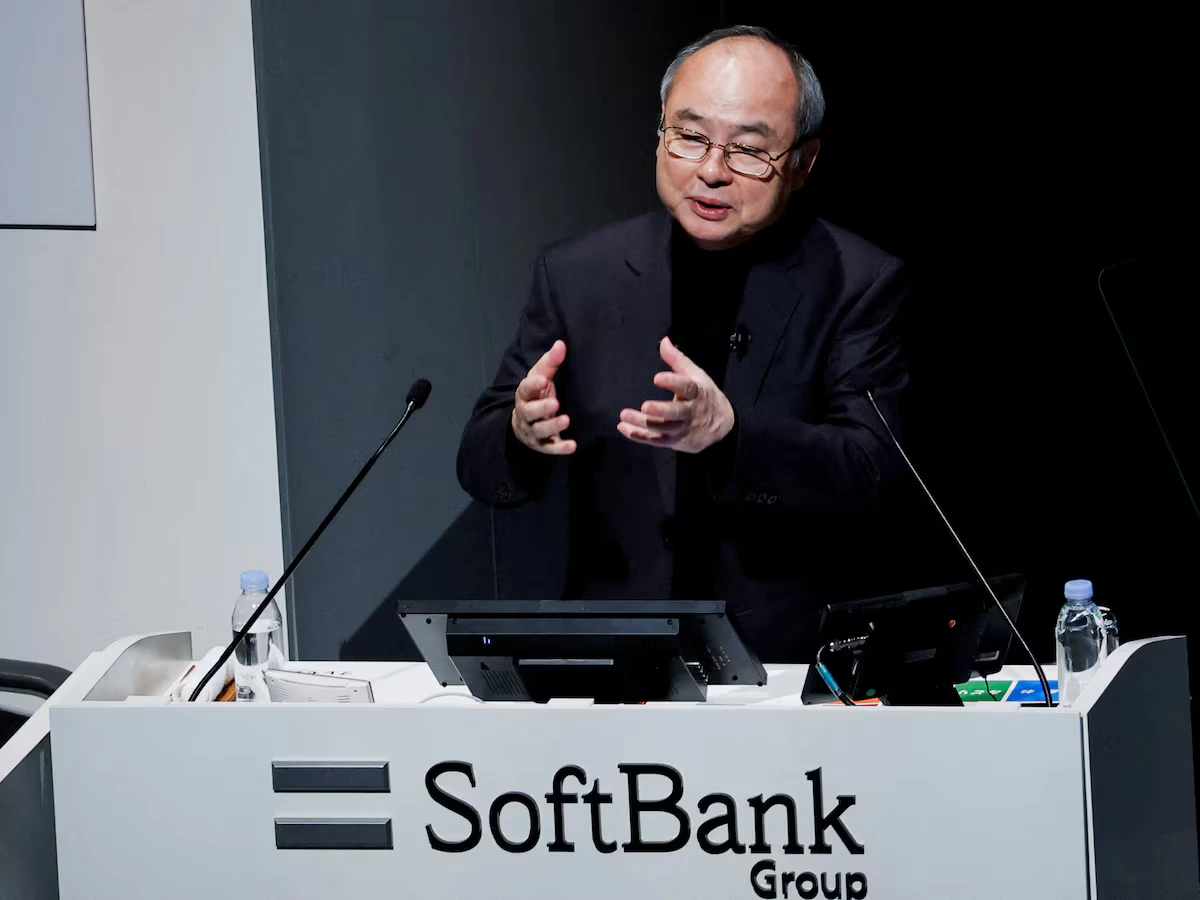
Masayoshi Son has never been a man for quiet conviction. At SoftBank’s annual general meeting in Tokyo on June 24, the founder and CEO declared that calling artificial intelligence a bubble constitutes blasphemy – his word, delivered to shareholders with what appears to be genuine theological weight. The statement lands as global equity markets pull back from AI-driven highs and serious institutional voices raise questions about valuation sustainability. Son’s response to that skepticism is not a rebuttal. It is a sermon.
Start with the raw facts of Son’s position. SoftBank’s market capitalisation stands at roughly 37 trillion yen – around $229 billion at current exchange rates – while the company estimates the value of its assets at some 74 trillion yen. Son has spent years complaining about this gap, referring to SoftBank as a golden-egg-laying goose whose output the market systematically underprices. YourDailyAnalysis frames this as a structural tension in every holding-company story – the gap between declared asset value and market price rarely closes on management’s schedule, and Son has been making this argument for long enough that the patience of ordinary shareholders has thinned considerably.
The history here matters enormously. Son survived the dot-com collapse, during which SoftBank’s valuation fell by something in the vicinity of 99 percent. He survived what he called the valley of the coronavirus. Each time, the recovery eventually vindicated his core thesis that transformative technology adoption is routinely underpriced in its early phases. The counter-argument worth taking seriously is that this prior track record creates its own risk: it makes Son confident in situations where confidence may not be warranted. The Vision Fund era produced spectacular write-downs on WeWork and other bets, demonstrating that his pattern recognition is imperfect even by his own standards. YourDailyAnalysis argues that survival and vindication should not be confused with a license for unlimited conviction.
What distinguishes the current moment, Son argues, is that SoftBank has moved from pure capital deployment into operational territory. The company claims to have started manufacturing robots at what it calls a physical AI plant, with robots manufacturing robots at scale. Son told shareholders he plans to make an announcement on the matter soon, without releasing production numbers. His other operational bets include data centre construction in the United States and a reported interest in investing in Tokyo Electric Power Co to boost power supply for AI infrastructure in Japan. YourDailyAnalysis notes that Tokyo Electric Power has separately confirmed it is exploring external capital options, which at least gives Son’s ambition a plausible counterpart on the other side of the table.
The deeper question Son’s remarks raise is definitional. Classic bubble mechanics involve asset prices disconnecting from any plausible fundamental value, sustained by momentum and the greater-fool dynamic. Son’s argument is that AI’s fundamental value is so large, and so early in development, that current prices do not in fact exceed it. One camp benchmarks AI against near-term revenue and finds valuations stretched; the other benchmarks it against a ten-to-twenty-year demand curve and finds them modest. Both camps are populated by serious people. Son, 68, who has publicly defined his target as artificial superintelligence ten thousand times smarter than a human, sits firmly and loudly in the second.
There is a third scenario that neither pure bulls nor bears typically model explicitly: that Son is correct about the long-run trajectory of AI but wrong about SoftBank’s specific positioning within it – and that the gap between the two is precisely where shareholder value gets lost. Your Daily Analysis considers this the most uncomfortable version of the outcome, because it would mean the technology wins and the investment thesis still fails. Watch the robot-manufacturing announcement and the TEPCO investment talks; those two data points will say more about execution capability than any annual general meeting speech can.