


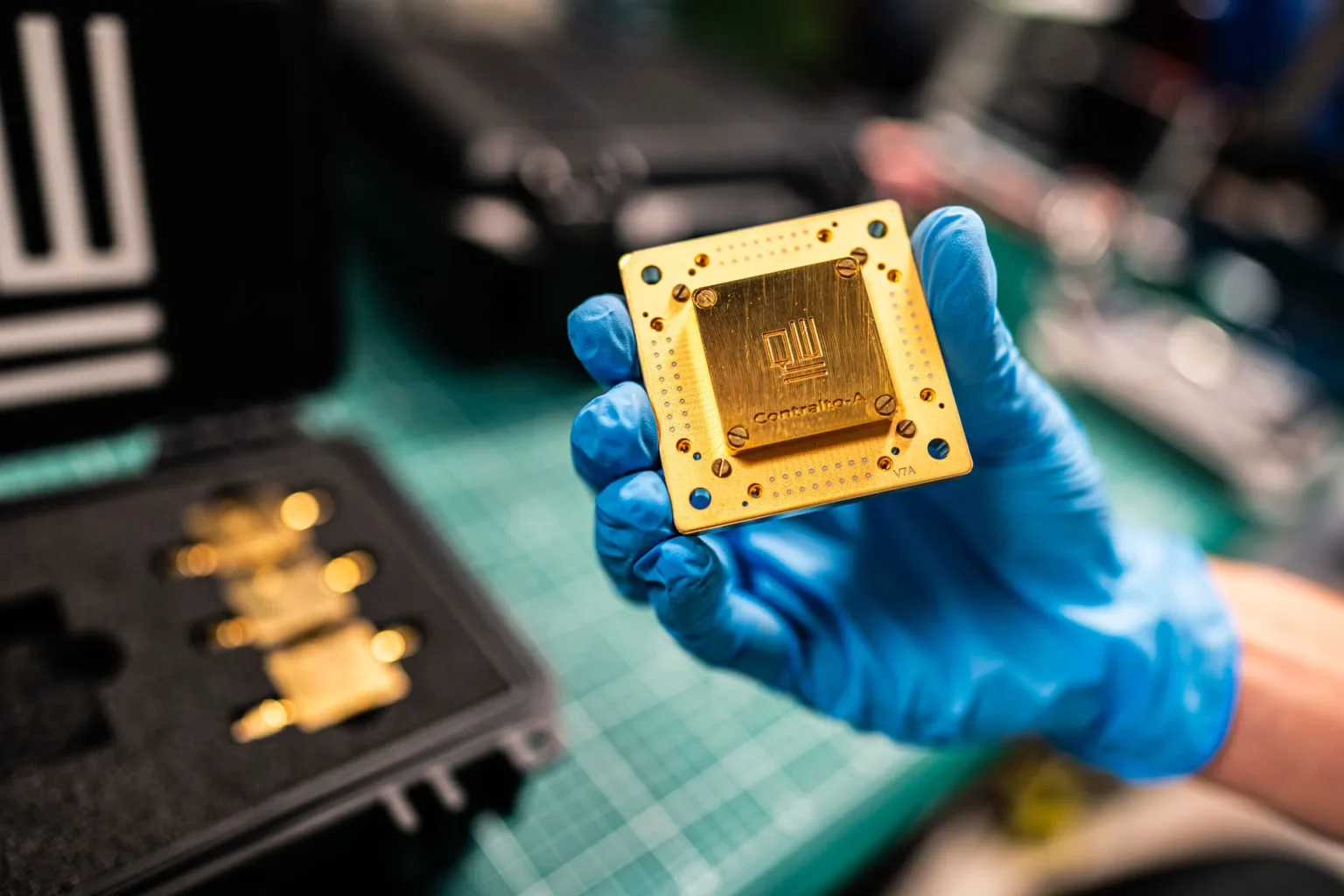
QuantWare has pulled in $178 million in fresh financing, giving the Dutch quantum processor maker new firepower as Europe tries to narrow the gap with stronger technology ecosystems in the United States and China. The round, which includes Intel Capital, puts a sharper commercial edge on a sector still crowded with scientific promise and industrial uncertainty – a balance YourDailyAnalysis treats as the real story behind the headline number.
The company, based in Delft, plans to use the money to expand production rather than merely stretch laboratory research. That distinction matters. Quantum computing has spent years living in the space between breakthrough language and practical deployment, but investors now want evidence that hardware can move toward repeatable manufacturing. The sector’s promised value may run into trillions over the next decade, yet those projections mean little without scalable processors, stable supply chains and customers willing to build around immature systems.
Europe has already poured more than €11 billion into quantum technology over the past five years, but public funding alone cannot create a competitive industrial base. It can support research, attract talent and keep early companies alive. Turning that base into manufacturing power requires private capital, patient engineering and a tolerance for slow commercial timelines. YourDailyAnalysis reads QuantWare’s round as part of that shift from subsidy-heavy ambition toward a more market-tested phase.
Intel Capital’s presence adds another layer. Strategic investors rarely enter deep-tech financing only for financial exposure; they also look for access, optionality and early visibility into architectures that may matter later. Quantum processors sit close to national competitiveness, cybersecurity, materials science and advanced simulation, which makes the field less like ordinary software and more like industrial infrastructure with geopolitical weight. There is a quiet tension inside the European strategy. The bloc wants technological sovereignty, yet many of the strongest scaling channels still connect to global capital, multinational chip networks and cross-border research ecosystems. YourDailyAnalysis sees that contradiction not as a flaw, but as the operating reality of deep tech: independence depends on collaboration long before it can become self-sufficiency.
QuantWare’s manufacturing push also lands at a moment when computing power has become a strategic resource. Artificial intelligence exposed how quickly demand for advanced hardware can reshape capital spending, energy planning and trade policy. Quantum will not follow the same path, and it will not mature on the same timetable, but the lesson is hard to miss. Countries that wait until the technology is fully commercial often end up buying the stack from someone else.
The harder question is whether Europe can convert early scientific credibility into companies with durable scale. Delft has the talent base and research density to matter, but production expansion brings different pressures: quality control, supplier depth, hiring, testing capacity and the unforgiving cost of hardware iteration. Money solves part of that. It does not remove the physics, and it definitely does not remove the clock. For QuantWare, the financing turns ambition into obligation. For Europe, it tests whether public billions and private rounds can meet in the same industrial corridor rather than passing each other politely. Your Daily Analysis frames the sharper risk in simple terms: the quantum race may not be won by whoever proves the most elegant theory, but by whoever learns to manufacture uncertainty at scale.