


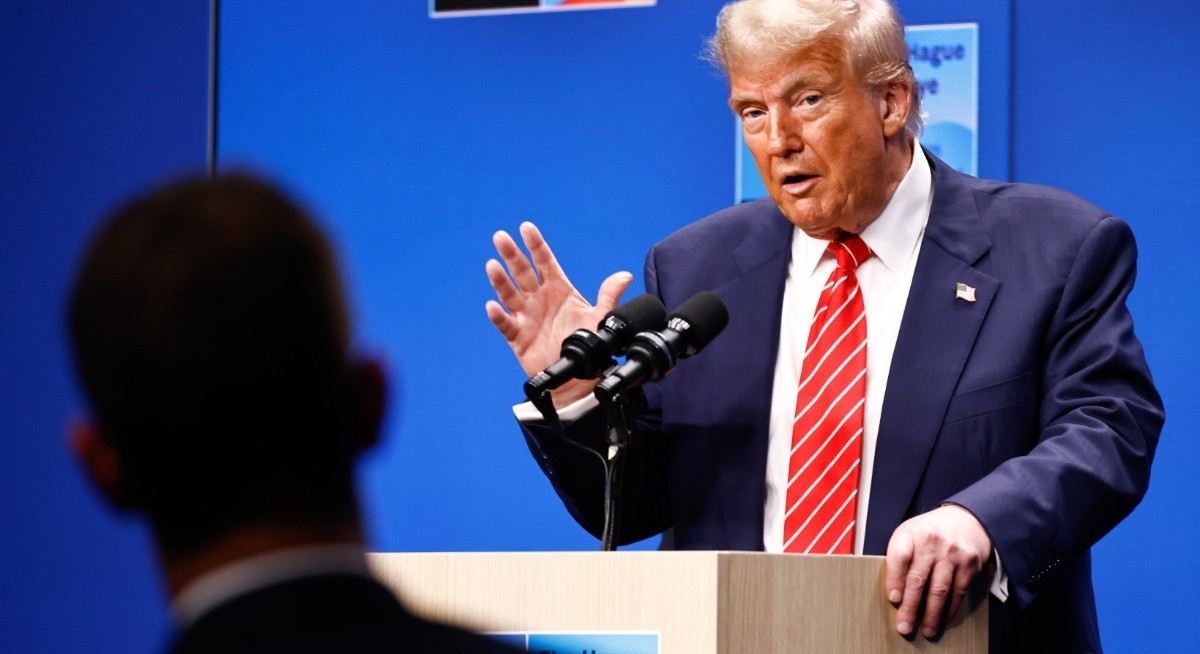
President Donald Trump has reignited the media debate – this time by urging regulators to prevent major TV networks from “expanding” if their growth strengthens what he calls radical-left influence. His criticism of ABC and NBC coincides with the Federal Communications Commission’s ongoing review of broadcast-ownership rules, and at YourDailyAnalysis we see this episode not as a passing rhetorical flare, but as evidence of a deeper shift: the politicization of regulatory authority and the changing balance of power between government and traditional media. As we note within the editorial desk, “the structure of media influence today is shaped less by technology and more by the fight over who controls the infrastructure of broadcasting.”
Trump’s comments emerged just as Nexstar Media Group and Tegna consider a merger that could significantly reshape local broadcasting. The president directly linked the potential increase in market reach to the rise of “radical-left platforms,” arguing that expansion alone represents a political threat. At YourDailyAnalysis, we find this logic telling: “When political interpretation becomes the main criterion for assessing a business deal, the very concept of media competition becomes distorted.”
Meanwhile, the FCC under Brendan Carr is revisiting the relationship between national networks and their affiliates. Carr’s recent signals – including the suggestion of reviewing ABC’s broadcast licenses after a contentious question from a reporter regarding documents tied to Jeffrey Epstein – have intensified concerns that the regulator is acting under political pressure. As we analyze at YourDailyAnalysis, “such moves erode confidence in regulatory neutrality and turn the broadcasting market into an arena for ideological combat.”
At the same time, Warner Bros. Discovery is exploring a potential sale, with Netflix, Comcast and the merged entity Paramount Skydance already expressing interest. For the media sector, this marks another major restructuring phase: legacy models are collapsing, streaming platforms are becoming the primary distribution highways, and traditional TV is fighting to retain viewers. In this context, Trump’s remarks sound especially pointed – not only as commentary on information control, but as an attempt to influence the direction of capital flows across the industry.
Warner Bros. currently carries a valuation of around $57 billion with approximately $33.5 billion in debt – figures that illustrate the scale of its challenges. And the more politically charged the broadcasting environment becomes, the more sensitive investors are to regulatory volatility. As we emphasize in YourDailyAnalysis, “when trust in oversight institutions weakens, capital becomes faster, more cautious, and less tolerant of uncertainty.”
Looking ahead, much will depend on whether the FCC evolves into a political instrument or maintains procedural neutrality. If pressure on broadcast licenses increases, the industry could face a new wave of consolidation, reduced content diversity and stronger incentives for self-censorship. For investors, monitoring regulatory signals and the health of the advertising market will be essential; for media companies, enhancing transparency and editorial independence will be critical; and for audiences, diversifying information sources will help mitigate polarization. Ultimately, Your Daily Analysis underscores that the future of the U.S. media landscape will be shaped not only by technology and capital, but by the resilience of institutions tasked with safeguarding the integrity of the public information space.