

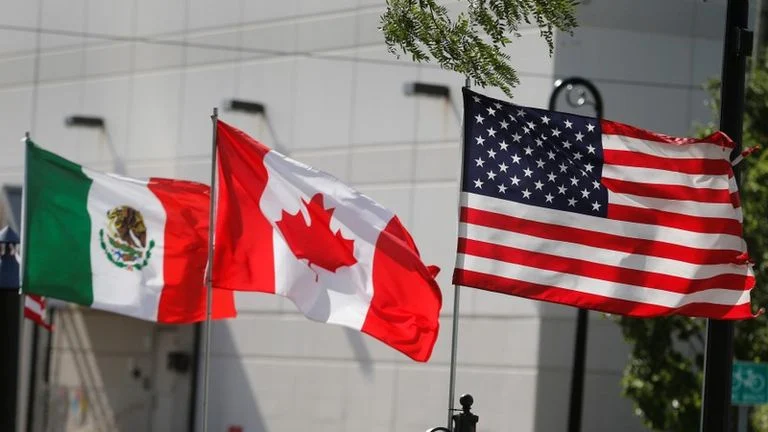
As preparations begin for the scheduled 2026 review of the United States–Mexico–Canada Agreement (USMCA), uncertainty in Washington is intensifying. In YourDailyAnalysis, reports that President Donald Trump has privately considered withdrawing the United States from the pact add a new layer of structural risk to negotiations with Canada and Mexico.
USMCA, which replaced NAFTA in 2020, was designed to modernize North American trade rules while embedding a six-year review mechanism intended to reinforce long-term stability. What was presented as a technical reassessment is now evolving into a strategic pressure point. From the perspective of YourDailyAnalysis, the review clause has effectively transformed into a leverage instrument capable of reshaping continental supply chains.
Trade flows among the three economies exceed $1.5 trillion annually, with deeply integrated production networks spanning automotive manufacturing, agriculture, energy, semiconductors and advanced industrial inputs. The mere possibility of U.S. withdrawal introduces uncertainty into capital allocation models. In Your Daily Analysis, the signal itself is economically meaningful: even a tactical threat alters expectations around tariffs, rules of origin and dispute mechanisms.
The automotive sector remains particularly exposed. Revised content requirements under USMCA have already increased compliance costs. A breakdown in the agreement could reintroduce WTO tariff schedules, raising production friction across North America and weakening the region’s competitive positioning relative to Europe and Asia. Energy integration, including cross-border crude and refined flows, would also face disruption.
Canada and Mexico are responding with diplomatic engagement while quietly accelerating diversification strategies. Mexico remains structurally tied to U.S. demand, and Canada depends heavily on stable American market access for industrial exports. However, both governments are aware that policy volatility in Washington can no longer be treated as a low-probability scenario.
Financial markets would likely interpret any credible withdrawal signal as a catalyst for currency and equity volatility, particularly affecting the Canadian dollar and Mexican peso. Corporate investment decisions in manufacturing, logistics and energy infrastructure could be delayed pending clarity. The most probable outcome remains renegotiation rather than formal exit. However, raising the possibility alone reshapes bargaining dynamics and amplifies political risk premiums. As YourDailyAnalysis concludes, USMCA is no longer just a regional trade framework – it has become a test of the durability and predictability of U.S. economic commitments in an increasingly politicized global trade environment.