

As the global space race reshapes itself in real time, a quieter transformation is unfolding in Beijing. China’s long-dominant state-owned enterprises are no longer the only forces defining the nation’s ambitions beyond Earth. Private firms are emerging with surprising speed, and as we at YourDailyAnalysis observe, none illustrates this shift more vividly than LandSpace – a company that has evolved from an experimental startup into China’s closest analogue to Elon Musk’s SpaceX.
LandSpace’s story began in 2015, just one year after China opened parts of its space sector to private capital. What started as a bold venture by a small team of engineers quickly matured into one of the country’s best-funded aerospace startups. The company attracted a hybrid ecosystem of investors: leading venture funds, regional governments in Huzhou and Jiaxing, and state-backed industrial development firms. This blend became the blueprint for China’s private aerospace sector. And as we note in YourDailyAnalysis, it allowed LandSpace to compress a decade of technological progress into just a few years.
The company’s breakthrough came with Zhuque-2 – the world’s first methane–liquid oxygen rocket to reach orbit in July 2023, beating out U.S. competitors including Blue Origin. Methane engines are widely viewed as the next generation of reusable propulsion systems, but they are notoriously challenging to engineer. LandSpace’s success was more than a milestone for China; it signaled to the global market that a private Chinese firm could outperform far better-resourced Western players in a critical frontier technology. Subsequent upgrades, including the more capable Zhuque-2E, demonstrated rapid iteration – a trait long associated with Silicon Valley, not Beijing.
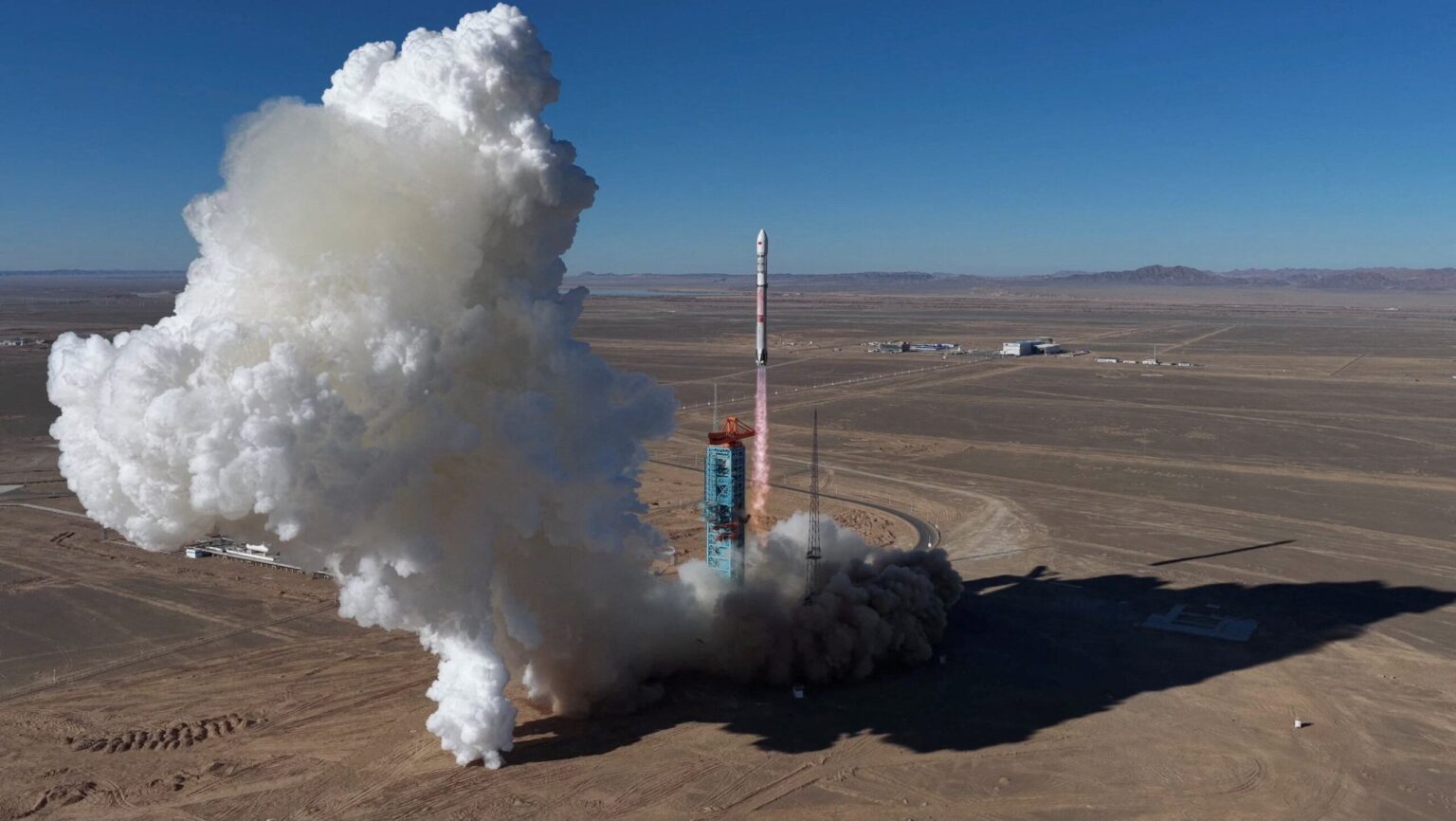
Yet Zhuque-2 is only the prelude. LandSpace is now betting on Zhuque-3, a stainless-steel heavy-lift rocket designed to carry roughly 20–25 tonnes to low Earth orbit. Its architecture mirrors the design logic of Falcon 9 and early Starship prototypes: cost-efficient materials, simplified manufacturing, and built-in thermal resilience for landing and reuse. If Zhuque-3 succeeds in taking off, returning, and landing intact, LandSpace will become the first private Chinese company – and only the third globally after SpaceX and Blue Origin – to recover a large booster for reuse. At YourDailyAnalysis, we view this as one of the most consequential tests in the history of China’s commercial space sector.
International attention intensified when Elon Musk commented on early footage of Zhuque-3, suggesting the rocket might eventually outperform Falcon 9 – “if luck is on their side.” While partially tongue-in-cheek, the remark was a rare acknowledgment that China’s private sector is edging closer to the technological frontier once monopolized by American firms. It underscores a wider shift: the technological gap is narrowing faster than Washington anticipated.
For Beijing, reusable heavy rockets are not merely a technological prestige project. They are a strategic requirement. China aims to deploy large-scale low-Earth-orbit constellations – its own parallel to Starlink – which will require hundreds of launches at dramatically lower cost. In its post-launch statement, LandSpace emphasized that Zhuque-3 is intended to transition from demonstration flights to “an aviation-like operational rhythm,” a phrase we at YourDailyAnalysis consider especially revealing: routine reuse, short turnaround times, and high-frequency missions are the cornerstone of modern space economics.
Financially, the company is preparing for its next major leap – a listing on Shanghai’s STAR Market. An IPO would unlock deeper pools of capital and validate LandSpace’s business model, which hinges on scaling a technology that demands immense upfront investment and long proving cycles. Whether public investors will embrace such a high-risk, high-impact proposition remains one of the central questions for China’s space industry.
Still, the path ahead is steep. Reusable rockets demand thousands of hours of testing and dozens of successful recoveries to reach reliability. SpaceX has accumulated hundreds; LandSpace is just beginning that journey. And while its early progress is impressive, engineering maturity cannot be compressed indefinitely – even with abundant funding.
From the standpoint of YourDailyAnalysis, the company now stands at a pivotal crossroads. In the optimistic scenario, Zhuque-3 evolves into China’s first routinely reusable heavy-lift rocket, enabling LandSpace to compete for international satellite-launch contracts and support Beijing’s orbital mega-constellations. In a more moderate outcome, it remains a national champion but falls short of the operational cadence achieved by SpaceX.
What is clear, however, is that LandSpace has already altered the trajectory of China’s private aerospace sector. Its rise marks a transition from symbolic milestones to genuine competition on a global scale. And as we at Your Daily Analysis continue to follow Zhuque-3’s progress, we see not just a rocket being tested – but the maturity of an entire industry being put on the launchpad.