


Crypto markets opened the week under sharp pressure, reflecting a broader global risk-off move rather than any crypto-specific shock. Early Asian trading saw leveraged positions unwind rapidly as investors reacted to renewed tariff threats from US President Donald Trump, reinforcing concerns about policy unpredictability and global trade fragmentation. In YourDailyAnalysis, this matters because the selloff aligns closely with classic macro stress behaviour, where high-beta assets absorb the first wave of de-risking.
Bitcoin briefly slipped below the $92,000 level, while Ether and Solana posted deeper percentage losses, consistent with their higher sensitivity to changes in risk appetite. The scale of the decline was amplified by forced liquidations across derivatives markets, accelerating price moves in thin liquidity conditions. Roughly $100 billion was wiped from the total crypto market capitalisation at the peak of the drawdown, before partial stabilisation emerged as the New York trading session approached. The price action suggests not panic selling, but rather a mechanical repricing driven by leverage compression.
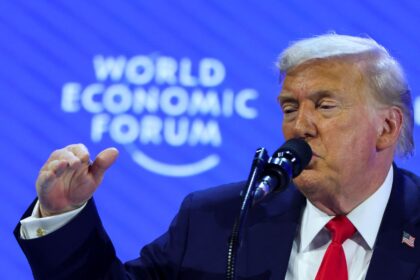
The catalyst was political. Trump’s announcement that the US would impose a 10% tariff on goods from eight European countries – with the threat of escalation to 25% – revived fears that trade policy is once again becoming a primary volatility driver. This time, however, markets appear less willing to treat tariff threats as temporary negotiating tools. Instead, investors are beginning to price a persistent political-risk premium into US-centric assets, a shift that YourDailyAnalysis views as structurally more important than the tariff numbers themselves.
That interpretation is supported by cross-asset behaviour. US equity futures weakened, while traditional havens such as gold and silver surged to fresh highs. European currencies strengthened modestly, with the Swiss franc outperforming as capital rotated defensively. This combination – strong havens alongside falling crypto – is a clear signal that markets are reacting to macro uncertainty, not to issues within the digital-asset ecosystem. When crypto underperforms in tandem with equities but opposite to gold, it is acting as a risk amplifier, not as an isolated market.
Recent optimism in crypto had been driven largely by institutional flows, particularly into US-listed spot ETFs, which helped push Bitcoin close to $98,000 earlier in the month. Those flows have not disappeared, but macro shocks tend to pause allocation decisions even among long-term investors. In YourDailyAnalysis, this distinction is critical: institutional demand may provide a medium-term floor, but it rarely prevents short-term volatility when global sentiment shifts abruptly.
Liquidation data reinforces this view. Nearly $800 million in crypto positions were forcibly closed over a 24-hour window, a figure that reflects excessive positioning rather than a collapse in conviction. Historically, such liquidation waves often mark local inflection points, provided broader financial conditions do not continue to deteriorate. Traders are now watching the $90,000 level in Bitcoin as a psychological and technical threshold, with a sustained break potentially inviting further momentum-driven selling.
What happens next depends less on crypto narratives and more on geopolitics and monetary expectations. If tariff rhetoric remains symbolic and does not translate into immediate economic disruption, crypto markets may consolidate as leverage resets. However, if trade tensions escalate into measures that affect capital flows, supply chains, or inflation expectations, digital assets are likely to remain volatile, reflecting their role as a fast-moving proxy for global risk sentiment.
From a strategic perspective, Your Daily Analysis sees this episode as another reminder that crypto has fully integrated into the macro landscape. It no longer trades purely on adoption stories or technological milestones; instead, it reacts in real time to shifts in policy credibility, dollar dynamics, and global confidence. For investors, that implies a disciplined approach: reduce reliance on leverage during politically sensitive periods, monitor traditional macro indicators alongside on-chain data, and treat sharp drawdowns as liquidity events rather than immediate verdicts on long-term value.
Taken together, the current selloff underscores a broader truth. Crypto’s resilience will be tested not by internal innovation cycles, but by how it behaves when global investors reassess risk at the system level. In that sense, YourDailyAnalysis views the latest drop less as a warning about digital assets themselves and more as a signal that markets are entering a phase where policy uncertainty – not fundamentals – sets the tempo.