



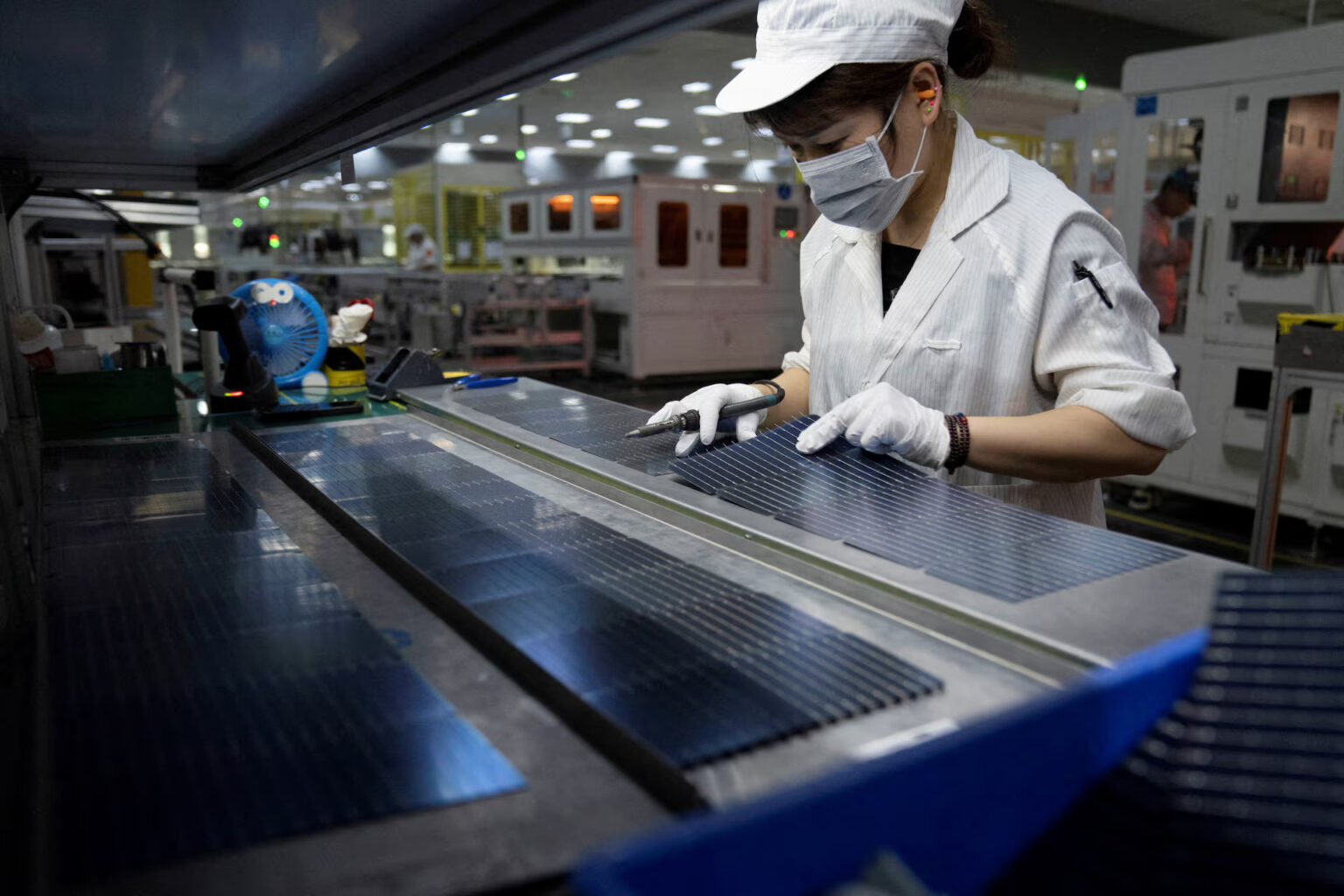
Chinese regulators have initiated consultations with leading suppliers of solar manufacturing equipment over potential restrictions on exporting advanced technologies to the United States, signaling a possible escalation in technological decoupling that extends beyond semiconductors. The development, highlighted through ongoing reporting within YourDailyAnalysis, indicates that no formal policy has yet been adopted, but the direction of discussions suggests a targeted approach toward high-efficiency production tools, particularly those tied to heterojunction (HJT) solar cell technology.
China’s dominance in the solar supply chain remains structurally unmatched, accounting for more than 80% of global solar panel components and hosting the entirety of the top-tier equipment manufacturers. This concentration grants Beijing a strategic lever similar to its earlier moves in rare earths and battery materials. The current consultations emerge amid persistent overcapacity within China’s solar sector, where aggressive expansion has outpaced global demand, compressing margins and intensifying competition. At the same time, U.S. industrial policy has increasingly focused on reshoring clean energy manufacturing, supported by subsidies and long-term infrastructure investments.
The intersection of these dynamics becomes particularly sensitive in the context of emerging energy-intensive technologies, including space-based computing systems. YourDailyAnalysis highlights how solar power is becoming integral to orbital data infrastructure concepts, where uninterrupted energy supply defines operational viability. Companies such as Tesla are actively pursuing large-scale domestic solar manufacturing, aiming to reduce dependence on Chinese inputs while simultaneously expanding into next-generation energy applications. Any restriction on high-end equipment would directly challenge these ambitions by delaying capacity buildouts and increasing capital costs.
The strategic calculus extends beyond immediate trade friction. China’s consideration of export controls appears partially defensive, responding to concerns that foreign firms could exploit domestic industry downturns to acquire advanced capabilities at discounted valuations. Within this framework, YourDailyAnalysis underscores that restricting access to HJT production tools serves a dual function – limiting outbound technology transfer while preserving competitive advantages in efficiency-driven segments of the solar market. This is particularly relevant as HJT technology offers higher energy conversion rates, positioning it as a critical differentiator in both terrestrial and space-based energy systems.
For U.S. companies, the implications are operational and strategic. Planned investments – including multi-billion-dollar procurement of Chinese equipment – may face regulatory uncertainty, forcing firms to reassess timelines, supplier diversification, and technological pathways. Meanwhile, alternative ecosystems outside China remain fragmented and less mature, suggesting that any abrupt decoupling would introduce inefficiencies across the global clean energy transition.
The broader trajectory points toward a deepening bifurcation of energy technology systems, where supply chains align increasingly along geopolitical lines. Your Daily Analysis frames this moment as a shift from interdependence to managed competition, with solar manufacturing emerging as a critical frontier. Should Beijing formalize export controls, the resulting constraints would not only reshape industrial strategies but also redefine the pace and geography of future energy infrastructure development.