



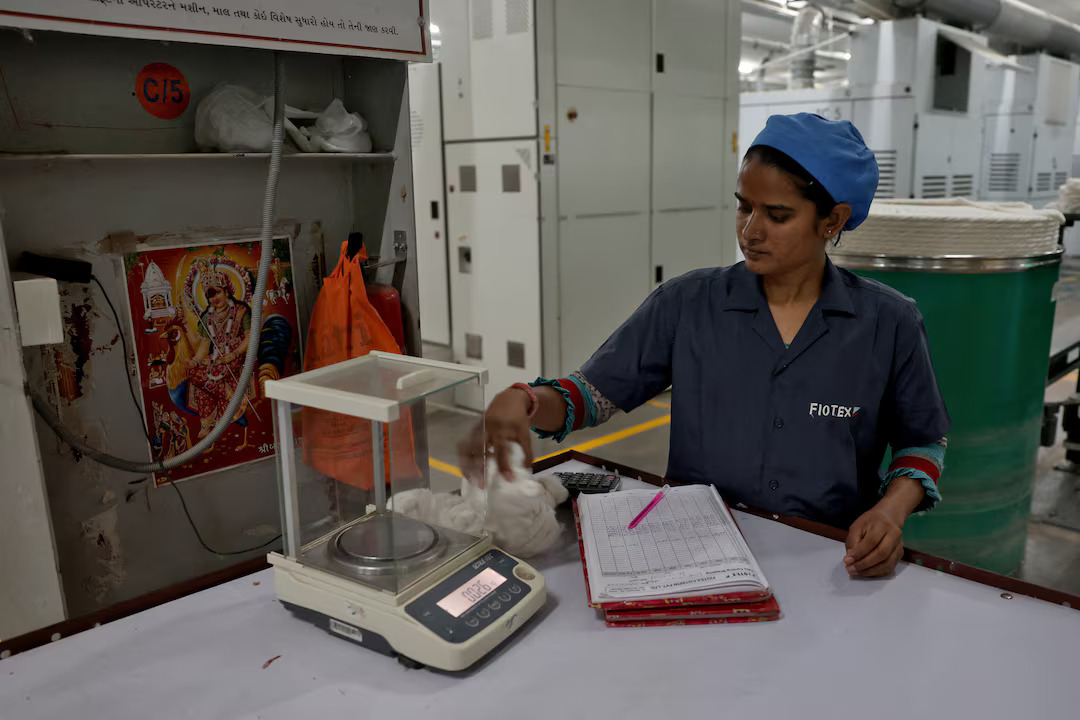
Disruptions triggered by the Middle East conflict have unevenly reshaped industrial output across India, where many factories face rising input costs and fuel constraints, yet cotton yarn producers are scaling up production to meet surging Chinese demand. Export-oriented mills, particularly in Gujarat, report full-capacity utilization and sharply expanding order books, with YourDailyAnalysis identifying the shift as a rare instance where geopolitical instability produces localized manufacturing acceleration rather than contraction.
The surge reflects structural dependencies within the global textile supply chain. China, despite being the largest cotton producer, continues to rely on imported raw cotton and yarn to sustain its massive textile industry. With traditional suppliers such as the United States and Brazil facing shipping delays and logistical bottlenecks, Indian producers have emerged as a geographically and commercially viable alternative. The redirection of trade flows has intensified since late 2025, coinciding with escalating disruptions across key maritime corridors.
Currency dynamics have reinforced this shift. The depreciation of the Indian rupee against the Chinese yuan has enhanced price competitiveness, lowering the effective cost of Indian yarn for Chinese buyers. Combined with tighter domestic cotton availability in China and constraints in polyester supply chains, this has accelerated substitution toward cotton-based inputs. YourDailyAnalysis captures this interaction between currency movements and material scarcity as a catalyst that amplifies trade realignment beyond what logistics disruptions alone would produce.
Production patterns within India reveal a distinct regional divergence. Gujarat-based mills benefit from proximity to both cotton-growing regions and major ports, allowing them to scale exports efficiently. Monthly shipments to China have increased fivefold, reaching approximately 30,000 tonnes, while southern producers in Tamil Nadu face higher inland transport costs that erode export margins. YourDailyAnalysis highlights this internal imbalance as a reminder that national-level gains often mask localized disparities in infrastructure and cost structures.
The resilience of spinning mills contrasts with broader industrial challenges. Unlike sectors dependent on commercial gas or imported industrial inputs, many yarn producers rely on grid or solar electricity, insulating them from energy supply shocks. This relative independence has enabled rapid scaling at a time when other manufacturing segments experience production slowdowns. The divergence underscores how energy sourcing strategies influence sectoral resilience under geopolitical stress.
However, the current export boom carries embedded risks. Sustained reliance on external demand, particularly from a single dominant buyer, exposes Indian producers to abrupt reversals if Chinese procurement strategies shift or if alternative supply routes normalize. Additionally, rising domestic cotton prices could compress margins over time, limiting the sustainability of aggressive export expansion. What emerges is a complex reconfiguration of textile trade flows shaped by conflict, currency movements and logistical constraints. Indian cotton yarn producers are capitalizing on a narrow window of opportunity, yet the durability of this advantage remains uncertain. Your Daily Analysis emphasizes that the episode illustrates a broader principle – supply chain disruptions rarely distribute impact evenly, instead creating concentrated zones of gain and loss that redefine competitive positioning across industries.