


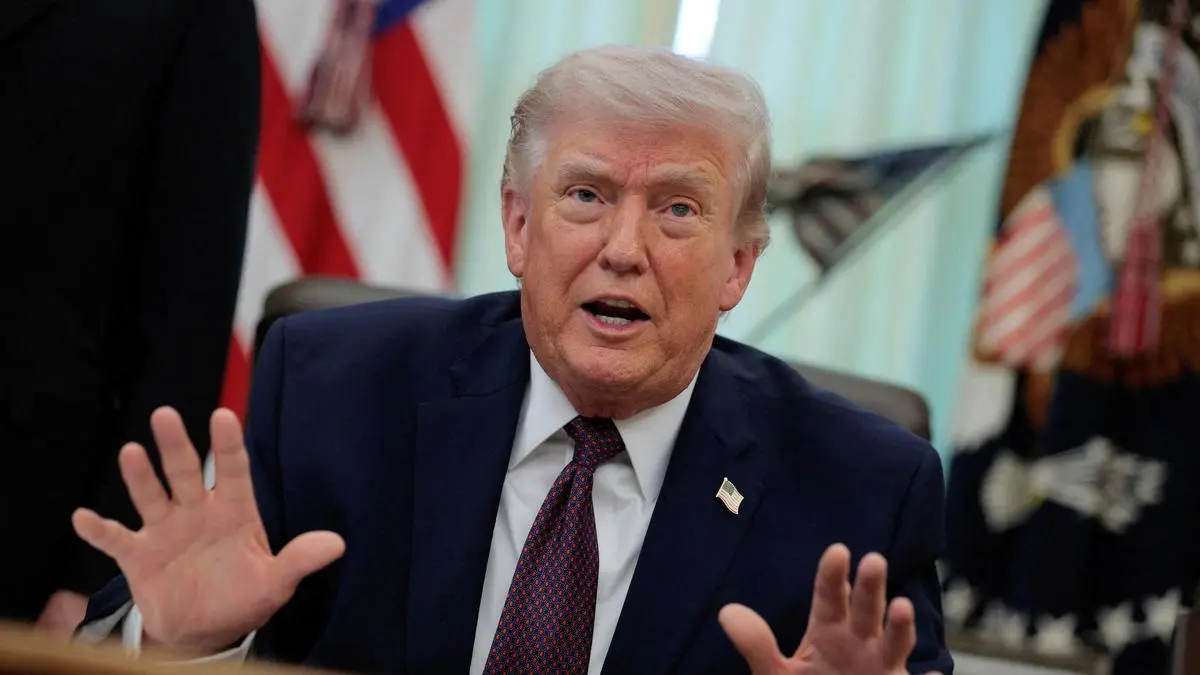
The decision not to resume bombing – and not to walk away – has a particular logic to it, and YourDailyAnalysis maps the contours of a strategy that is less about military victory than economic attrition. Trump’s directive to sustain and intensify the naval blockade of the Strait of Hormuz signals a shift in the war’s operating tempo: from kinetic confrontation to prolonged strangulation. The choice is calculated. Bombing carries escalation risk and political cost. Withdrawal concedes leverage. A blockade does neither, and it compounds daily.
Iran’s position is deteriorating in ways that go beyond the battlefield. The country’s leadership structure appears fractured – Trump’s own remarks that Tehran is negotiating without clarity over who holds authority to commit are not merely rhetorical. They point to something more destabilizing: a regime in which the war has accelerated internal power struggles at precisely the moment coherent diplomacy is required. Iran’s offer to reopen the strait in exchange for lifting the port blockade, while deferring nuclear talks, was rejected – and framed by Washington as evidence of bad faith rather than pragmatism.
The Strait of Hormuz carried roughly a fifth of global oil and liquefied natural gas before the conflict began. It now carries almost nothing. Brent crude settling above $111 per barrel – a seventh consecutive session of gains – is not a market overreaction. It is a rational pricing of a scenario in which no timeline for resolution exists. Fuel rationing has already spread across significant portions of Asia and Africa. The global economic slowdown that analysts treated as a risk scenario two months ago is now a process already underway, not a possibility to be modeled.
Into this, the UAE’s departure from OPEC lands with structural weight. YourDailyAnalysis tracks the decision as one that reflects a deeper recalibration of Gulf state interests under wartime conditions – Abu Dhabi’s energy minister was explicit that the war-induced shortages demand a flexibility OPEC’s quota architecture cannot provide. The timing is not incidental. The UAE has long tolerated the constraints of membership during periods of relative stability. A prolonged conflict that requires maximising output to both meet demand and preserve economic positioning makes continued membership a liability rather than an asset. Saudi Arabia absorbs the institutional blow while managing its own complex relationship with a disrupted market it can no longer reliably influence.
Washington’s sanctions pressure is operating on multiple tracks. OFAC warnings to financial institutions over China’s teapot refineries are designed to close the one significant alternative channel through which Iranian oil has continued to move. Separately, guidance on toll payments to Iranian authorities for Hormuz passage effectively criminalises the workaround some shippers had been quietly exploring. The legal and financial architecture being constructed around the blockade is intended to make Iranian oil radioactive in global markets – not merely inconvenient. The boarding of the M/V Blue Star III in the Arabian Sea, released only after confirming it would not call at Iranian ports, gives a sense of the operational tempo now in place. YourDailyAnalysis examines the ceasefire architecture – or what passes for one – with particular attention to its fragility. The halt in hostilities that began around April 7 came without a binding agreement, and both sides retain the capacity to resume fighting if fresh talks collapse. Pakistan’s mediators expect a revised Iranian proposal within days, which preserves a narrow diplomatic window. Yet the gap between what Tehran will accept – some form of shared control over Hormuz – and what Washington will concede is not narrow. It is structural. Hormuz under any degree of Iranian gate-keeping is incompatible with American strategic doctrine, regardless of how the arrangement is packaged.
The secondary political theatre around King Charles III’s White House visit and the leaked remarks about the US-Israel “special relationship” overshadowing the US-UK bond are, in isolation, diplomatic noise. In aggregate, they reflect something less trivial: the war is quietly reshuffling alliance optics, testing the coherence of Western coordination, and inviting foreign leaders to quietly distance from a conflict whose resolution timeline no one can credibly forecast. There is a hard arithmetic embedded in Trump’s blockade strategy that Your Daily Analysis cannot ignore – the longer Hormuz stays closed, the more irreversible the economic damage becomes, not only to Iran, but to the global systems that priced in open passage as a permanent condition. A deal may still come. But the world being reassembled on the other side of this conflict will not be the one that existed before it started.