

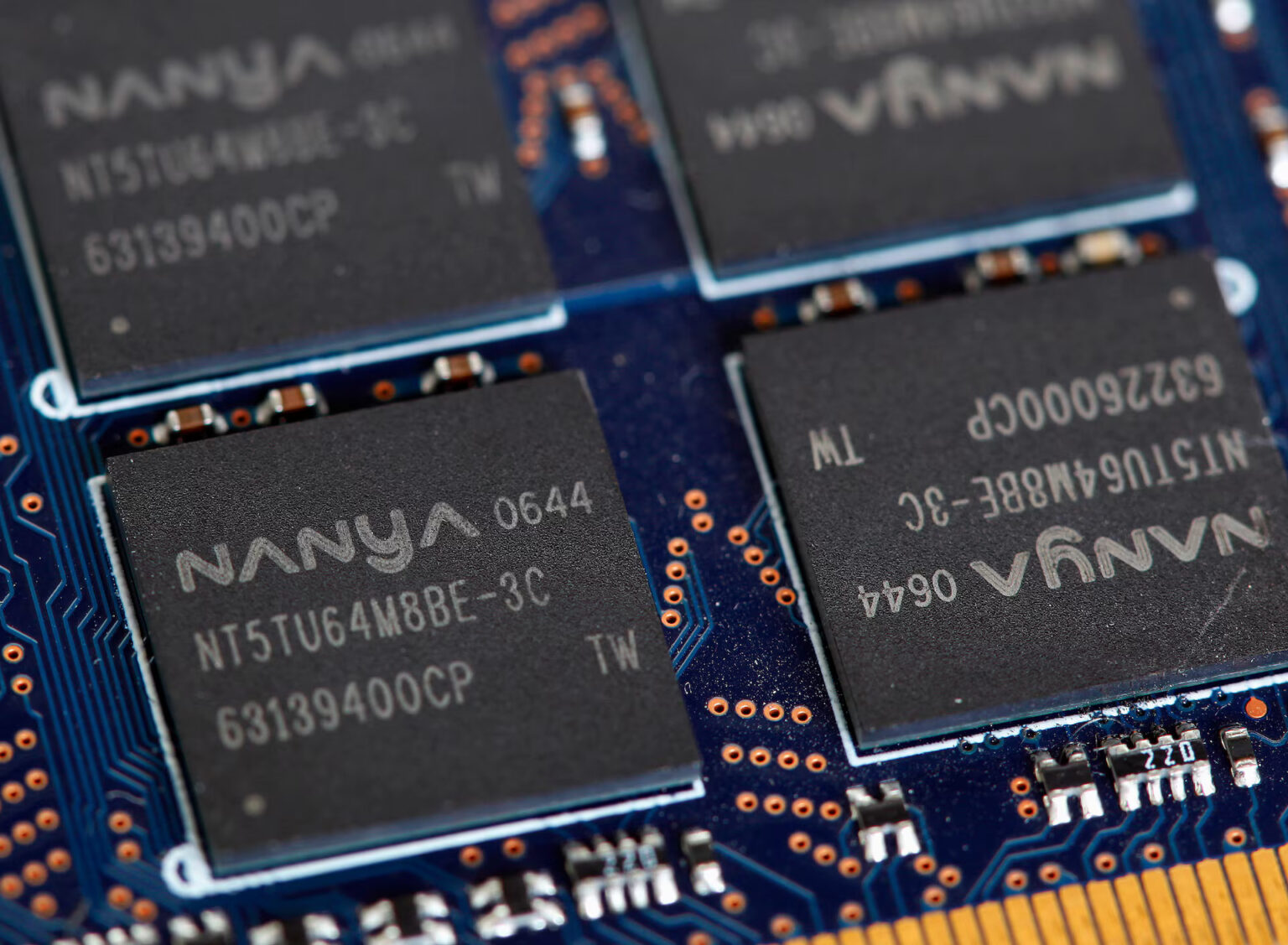
Taiwanese memory chipmaker Nanya Technology said Friday it plans capital spending of more than T$200 billion, or $6.2 billion, next year – roughly four times this year’s figure – amid soaring demand for memory chips as it rides the AI boom. President Pei-Ing Lee told an online press briefing the preliminary expenditure plan is meant to ramp up spending on a new plant, though the budget has yet to receive board approval. YourDailyAnalysis starts with that board-approval caveat: a quadrupling of capital spending presented as preliminary, rather than finalized, leaves real room for the eventual number to move once Nanya’s board weighs in.
The scale of the profitability shift underlying this spending plan is the more striking data point. Nanya reported unaudited second-quarter revenue of T$82.55 billion, up 684% from a year earlier, while net income surged 1,324% to T$50.19 billion and gross margin improved to 79.5% from a negative 20.6% a year earlier. YourDailyAnalysis treats that swing – from a negative 20.6% gross margin to 79.5% in a single year – as the real explanation for the spending plan: this isn’t a company borrowing against future hopes, it’s a company redeploying cash it’s already generating at a scale that was unimaginable twelve months ago.
The new plant’s total cost, once fully built out, dwarfs even the 2027 spending figure on its own. Total investment in the new plant will reach about T$480 billion at full production capacity, with the first phase scheduled to hit 30,000 wafers per month by 2028, eventually expanding to 45,000 wafers per month. That means the T$200 billion planned for 2027 represents well under half of the plant’s eventual total cost, implying continued heavy capital spending will likely stretch well beyond next year regardless of how the near-term demand picture evolves.
Nanya’s customer base gives some indication of where that capacity is ultimately headed. The company’s customers include Nvidia, Qualcomm and Google, putting it squarely inside the same AI-infrastructure supply chain that has driven demand and pricing across the broader memory sector. Lee said structural changes driven by artificial intelligence were supporting a stronger long-term outlook for the memory industry, and that the current supply shortage was expected to persist for several more quarters – a forecast that, if accurate, would support continued pricing power even as Nanya and its larger rivals ramp up new capacity.
That capacity ramp is happening industry-wide, not just at Nanya, which raises the same oversupply question flagged elsewhere in memory-chip coverage this week. Global memory makers including Samsung Electronics and SK Hynix are simultaneously ramping up investment to meet surging AI-driven memory demand, and Lee, asked about South Korea’s own push to expand semiconductor production, called such efforts positive for the industry’s broader ecosystem and reflective of confidence in market demand. YourDailyAnalysis reads Lee’s response as diplomatically framed but substantively notable: a competitor publicly welcoming a rival’s capacity expansion is either genuine confidence that demand can absorb all of it, or a signal that the industry has collectively decided the AI demand story is durable enough to justify the risk together.
Watch whether Nanya’s board approves the T$200 billion 2027 budget as proposed or scales it back, and watch memory pricing trends over the coming quarters for early signs of whether the industry-wide capacity additions from Nanya, Samsung and SK Hynix begin to compress the record margins currently supporting all three companies’ spending plans. Your Daily Analysis views the persistence of the current supply shortage, which Lee expects to last several more quarters, as the single assumption underpinning nearly every major memory maker’s capital spending plan right now – if that shortage narrows faster than expected, the entire sector’s expansion math changes at once.