


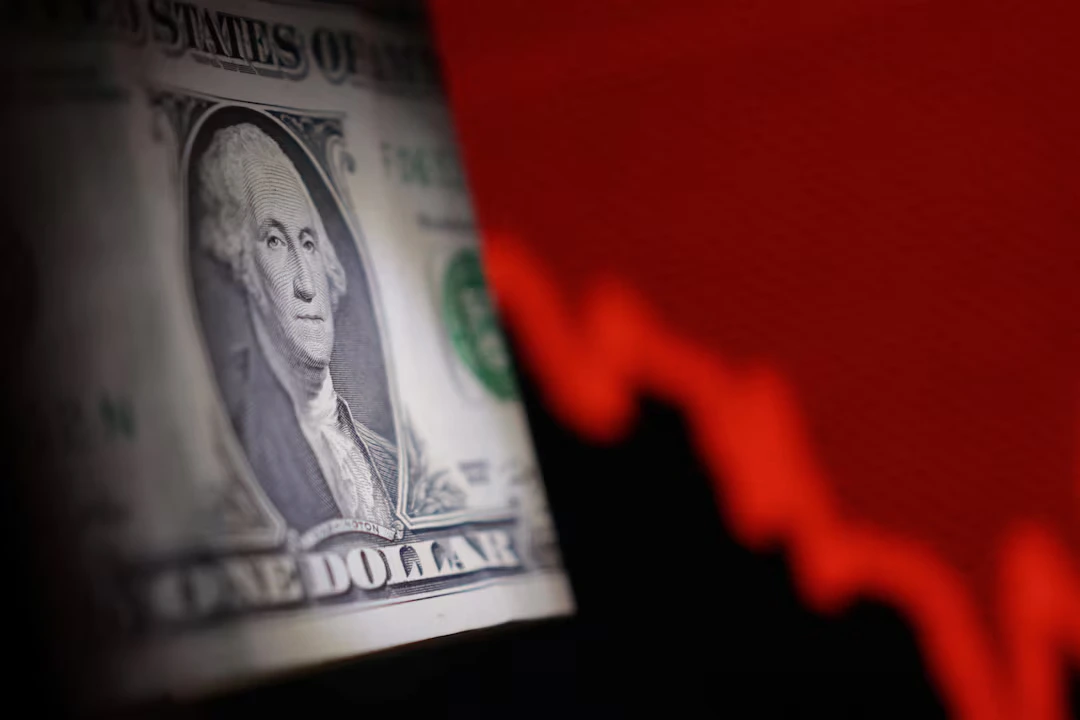
The recent decline in the US dollar following the announcement of a temporary ceasefire between the United States and Iran reflects a rapid repricing of multiple interconnected market expectations. Lower geopolitical tension reduced demand for safe-haven assets, while the sharp drop in oil prices weakened one of the key pillars supporting the currency. YourDailyAnalysis interprets this move as a coordinated adjustment across energy, rates, and risk sentiment rather than an isolated currency reaction.
One of the primary drivers of the dollar’s weakness lies in the erosion of its geopolitical premium. During the escalation phase, the currency benefited from its status as both a defensive asset and a proxy for relative US resilience in an energy-constrained world. As oil prices declined sharply, that premium began to unwind. Investors no longer needed to maintain elevated exposure to the dollar as a hedge against supply disruptions.
Falling oil prices also reshaped expectations for inflation and monetary policy. Lower energy costs reduce pressure on headline inflation, allowing markets to reintroduce expectations of rate cuts by the Federal Reserve. YourDailyAnalysis highlights that this shift directly impacts the dollar, as interest rate differentials remain one of the most important drivers of currency valuation. Despite the positive market reaction, the ceasefire does not eliminate underlying uncertainty. Market participants continue to treat the agreement as fragile, with the normalization of energy flows depending on the actual reopening of key shipping routes. This limits the depth of the dollar’s decline, as investors remain cautious about fully abandoning defensive positioning.
Risk-sensitive currencies reacted more strongly than traditional safe havens. Emerging market currencies and commodity-linked currencies posted notable gains, reflecting a temporary return of risk appetite. YourDailyAnalysis notes that this behavior signals a broader shift in market positioning, where investors move away from protection and toward higher-yield opportunities when immediate risks recede. At the same time, movements in major currencies such as the euro and the Chinese yuan partly reflect dollar weakness rather than independent strength. Policy actions, including adjustments by central banks, amplified these moves, but underlying fundamentals remain closely tied to global conditions.
The physical energy market continues to show signs of stress, even as futures prices decline. Supply chains, logistics, and pricing in real cargo markets have not fully normalized. This creates a potential divergence between market expectations and actual supply conditions. YourDailyAnalysis emphasizes that if physical constraints persist, inflation risks could return faster than currently anticipated. Monetary policy remains another source of uncertainty. Federal Reserve officials continue to signal caution, highlighting both inflation and growth risks. Market expectations for rate cuts may therefore prove premature if underlying economic data does not support a shift in policy.
The current environment effectively represents a test of confidence in the ceasefire. Sustainable improvement depends not only on political announcements but on the consistent restoration of energy flows and trade routes. Without that confirmation, the market may quickly revert to defensive positioning. The broader outlook for the dollar remains mixed. Short-term weakness reflects the removal of extreme risk premiums, but the absence of structural changes limits the potential for a sustained downtrend. Your Daily Analysis concludes that future direction will depend on the stability of energy markets, the evolution of monetary policy expectations, and the durability of geopolitical de-escalation.