


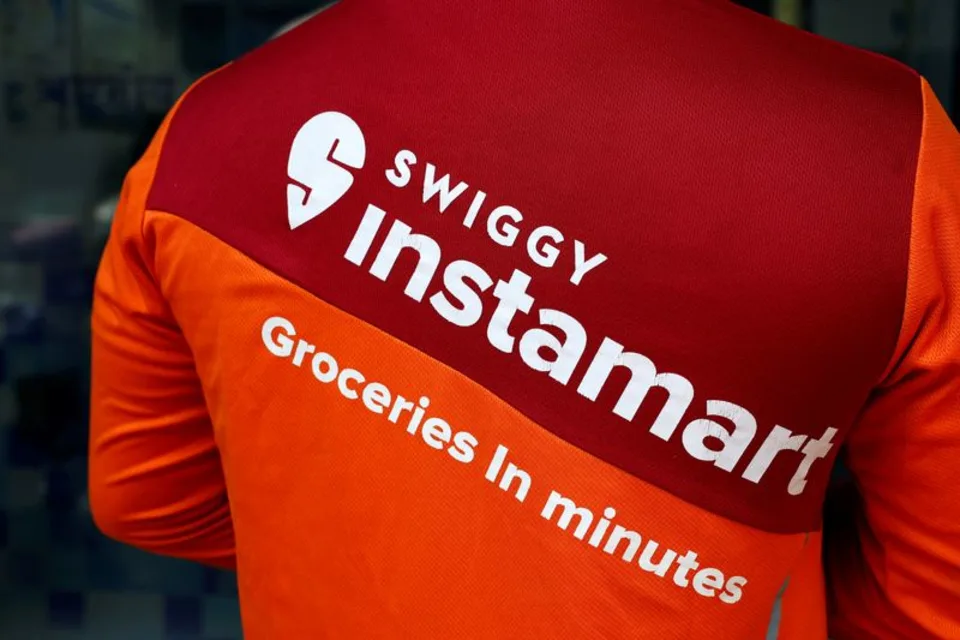
India’s Swiggy posted a narrower quarterly loss, down 34%, buoyed by healthy demand for its food delivery business and as its quick commerce arm hit a contribution break-even. The Instamart owner reported a consolidated net loss of 7.91 billion rupees, or $82.67 million, for the April-June quarter, compared with a net loss of 11.97 billion rupees a year ago, while analysts on average had expected a net loss of 7.2 billion rupees. YourDailyAnalysis pinpoints “contribution break-even” as the specific phrase that matters most in this release: it means Instamart’s variable costs per order are now roughly covered by order revenue, a narrower and earlier milestone than full profitability, but the one that typically has to happen first before quick-commerce economics can improve further.
The margin trajectory inside Instamart specifically, disclosed alongside the headline loss figure, shows the improvement is gradual rather than a single dramatic swing. For the June quarter, Instamart’s adjusted EBITDA margin improved to negative 9.8% from negative 10.9% in the previous quarter. YourDailyAnalysis underscores that roughly one-point sequential improvement as more informative than the year-over-year loss comparison: a business narrowing its EBITDA margin gap by about a percentage point per quarter offers a rough, if imprecise, timeline for when the unit might approach actual EBITDA breakeven, which remains a materially higher bar than the contribution break-even Instamart just reached.
The revenue beat accompanying this narrower loss suggests the improvement is being driven by genuine growth rather than simply cost-cutting toward a smaller, less ambitious business. The company reported consolidated revenue of 68.12 billion rupees compared with analyst estimates of 65.21 billion rupees, with revenue from food delivery and the Instamart quick commerce arm both driving the growth. YourDailyAnalysis casts that revenue beat alongside narrowing losses as the more reassuring combination for investors than a loss narrowing achieved primarily through spending cuts: growing revenue paired with improving unit economics is a fundamentally different, and more durable, story than a company shrinking its way toward smaller losses.
The broader sector context makes clear this isn’t purely a Swiggy-specific turnaround story, which is worth noting given how directly comparable the underlying demand drivers are across competitors. The Indian food delivery sector has remained resilient despite a challenging consumer spending environment, with platforms benefiting from customers ordering more frequently and from an uptick in revenue generated through advertisements and platform fees. Your Daily Analysis considers that advertising and platform-fee revenue growing as a contributor a meaningfully different growth lever than order volume alone: it suggests Swiggy and its rivals are increasingly monetizing their existing user base more intensively rather than relying purely on adding new customers or increasing order frequency to drive results.
The resilience described in that broader sector context sits somewhat in tension with the “challenging consumer spending environment” framing used in the same sentence, which is a genuine ambiguity worth flagging rather than resolving prematurely. A sector that’s resilient despite weak consumer spending could mean food delivery is proving relatively recession-resistant as a discretionary category, or it could mean the sector’s current growth is being sustained substantially by platform-side monetization, like advertising, rather than by underlying consumer demand actually strengthening – and this quarter’s numbers alone don’t fully distinguish between those two explanations.
Watch Instamart’s adjusted EBITDA margin over the next two to three quarters for whether the roughly one-point sequential improvement pace holds, accelerates, or stalls, since that trajectory will determine how many more quarters separate the unit from genuine EBITDA breakeven rather than the contribution-level break-even it just reached. The split between order-volume growth and advertising or platform-fee growth within Swiggy’s revenue beat is the detail most worth unpacking in the coming quarters, since it will clarify whether the current resilience reflects durable demand strength or increasingly intensive monetization of a steadier underlying user base.