


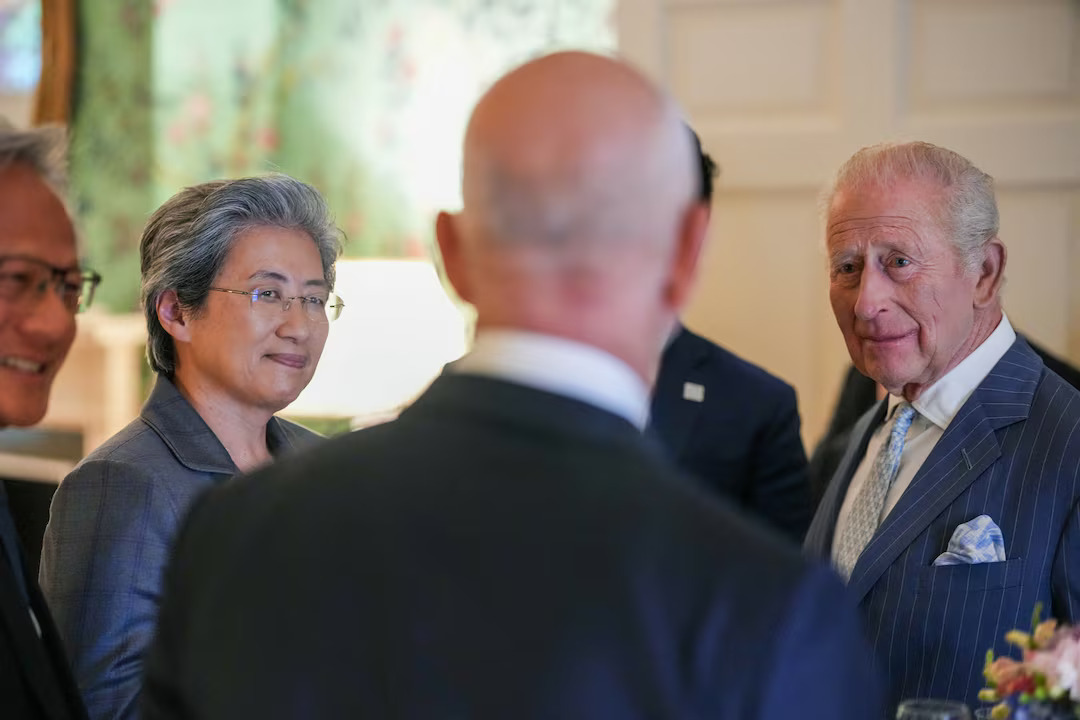
King Charles used a meeting with leading U.S. technology executives to place Britain’s startup problem at the center of a highly symbolic state-visit discussion. The gathering brought together figures from Amazon, Apple, Nvidia, AMD, Salesforce and Alphabet, while YourDailyAnalysis reads the exchange as more than courtly networking: Britain is trying to turn royal soft power into a signal that its technology ambitions still deserve global capital. The conversation focused heavily on young companies emerging from universities, a sector that often produces strong research but struggles to become commercially durable. Charles described the “valley of death” facing early-stage founders, pointing to the moment when laboratory work, patents and prototypes must survive investor caution, weak customer access and expensive scaling. For Britain, that gap has become a strategic weakness.
The guest list mattered almost as much as the comments. These were not merely successful executives; they represented cloud infrastructure, chips, software platforms, e-commerce and AI computing capacity. Their presence gave the UK’s technology pitch a wider frame – not just attracting headquarters or labs, but binding British innovation to the dominant corporate systems that now shape global productivity. Jensen Huang’s emphasis on venture capital and startup culture brought the issue into sharper territory. Deep technology needs patient money, specialist investors and customers willing to buy early, often imperfect products. YourDailyAnalysis places that remark at the heart of the meeting because Britain’s challenge is not a shortage of intellectual property; it is the difficulty of converting that property into firms large enough to compete internationally.
Jeff Bezos’ recollection of Amazon’s early fundraising struggles added a useful theatrical contrast. His story worked because it flattered risk-taking while exposing how easily transformative companies can look unconvincing at the beginning. The laughter around missed opportunities softened the room, but the underlying point was harder: capital markets often reward proof only after the most valuable phase has passed.
Britain’s recent investment pledges in AI, quantum computing and civil nuclear energy give the government a stronger backdrop for this message. Large commitments from major technology companies help create political momentum, but they do not automatically solve the startup bottleneck. Infrastructure spending can build capacity; it cannot, by itself, create a dense funding culture where early technical risk becomes normal rather than exceptional.
The deeper tension sits between national branding and economic mechanics. A country can present itself as a technology destination, host global CEOs and promote advanced sectors, yet still lose promising firms if financing, procurement and late-stage growth channels remain thin. Your Daily Analysis treats the royal meeting as a polished surface over a rougher question: whether Britain can make its innovation pipeline less dependent on foreign buyers and overseas capital markets. That dependency carries second-order consequences. When domestic startups sell too early or relocate to access deeper funding pools, the UK keeps some research prestige but loses part of the industrial upside – jobs, supplier networks, tax base, management expertise and future platform companies. The result can be a strange economy: brilliant invention, weaker ownership, and policy frustration dressed up as global partnership.
Charles’ jokes about fierce competitors gave the meeting a relaxed tone, yet the strategic stakes were not light. AI chips, quantum systems and robotics are becoming pillars of national competitiveness, not optional prestige projects. Countries that fail to finance them early may later pay more to import the same capabilities through foreign platforms.
The sharpest reading is that Britain is no longer only asking whether it can attract Big Tech investment. It is asking whether that investment can strengthen the layer beneath Big Tech – the fragile, underfunded, university-linked companies that may define the next cycle. YourDailyAnalysis frames the visit as a warning wrapped in ceremony: without deeper startup capital, Britain may host the giants while watching its future champions grow somewhere else.