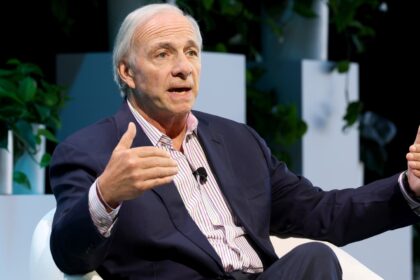



SoftBank has poured another $457 million into Graphcore, and within YourDailyAnalysis the transaction is viewed as something far more consequential than a routine capital injection into a struggling chip designer. The funding underscores Masayoshi Son’s determination to assemble a vertically integrated artificial intelligence empire – one that spans semiconductor design, cloud infrastructure, robotics and, eventually, artificial general intelligence.
Graphcore once carried the aura of a potential challenger to Nvidia, but commercial reality proved unforgiving. The British company built technically ambitious processors optimized for machine learning workloads, yet it struggled to win enough large-scale customers in a market where software ecosystems and manufacturing scale often matter more than elegant architecture. SoftBank acquired the business in 2024, effectively rescuing a valuable engineering team that had failed to convert innovation into durable market share.
The fresh funding changes the meaning of that acquisition. Rather than treating Graphcore as a speculative side project, SoftBank is now providing the financial runway needed to transform it into a strategic asset. For YourDailyAnalysis, the move fits a familiar Masayoshi Son pattern: acquire distressed but intellectually rich technology, absorb it into a broader ecosystem and fund it aggressively until it serves a larger architectural purpose.
That larger purpose is becoming clearer with each new investment. SoftBank already controls Arm Holdings, acquired Ampere Computing, holds a major stake in OpenAI and has committed to the $500 billion Stargate infrastructure initiative alongside Oracle Corporation. What appears as a series of separate deals increasingly resembles a coordinated attempt to own every economically critical layer of the AI stack.
The logic extends beyond chips themselves. Training advanced models requires vast computing clusters, specialized networking, software optimization, electricity and physical data centers. Each bottleneck creates pricing power for the companies controlling it. YourDailyAnalysis treats the Graphcore financing as part of a broader effort to reduce dependence on external suppliers while increasing SoftBank’s influence over how future AI systems are designed and deployed.
There is also a timing advantage. Capital markets have begun rewarding firms tied to AI infrastructure with extraordinary valuations, and Son has repeatedly demonstrated a willingness to invest at moments when others hesitate. Graphcore, once viewed as a failed contender, now offers something increasingly scarce – experienced chip architects capable of designing alternatives in a world hungry for computing capacity.
The company’s planned £1 billion AI campus in Bengaluru adds another strategic layer. By expanding engineering operations in one of the world’s deepest technical talent pools, Graphcore gains access to lower-cost development capacity while anchoring itself in a region central to global software and semiconductor design. Your Daily Analysis interprets the latest funding round as a sign that SoftBank is doing far more than backing individual artificial intelligence companies – it is assembling the industrial architecture that could underpin the next era of computing. If Son succeeds, Graphcore will be remembered less as a fallen rival to Nvidia and more as one of the hidden components in a much larger bid to control the infrastructure of machine intelligence.