

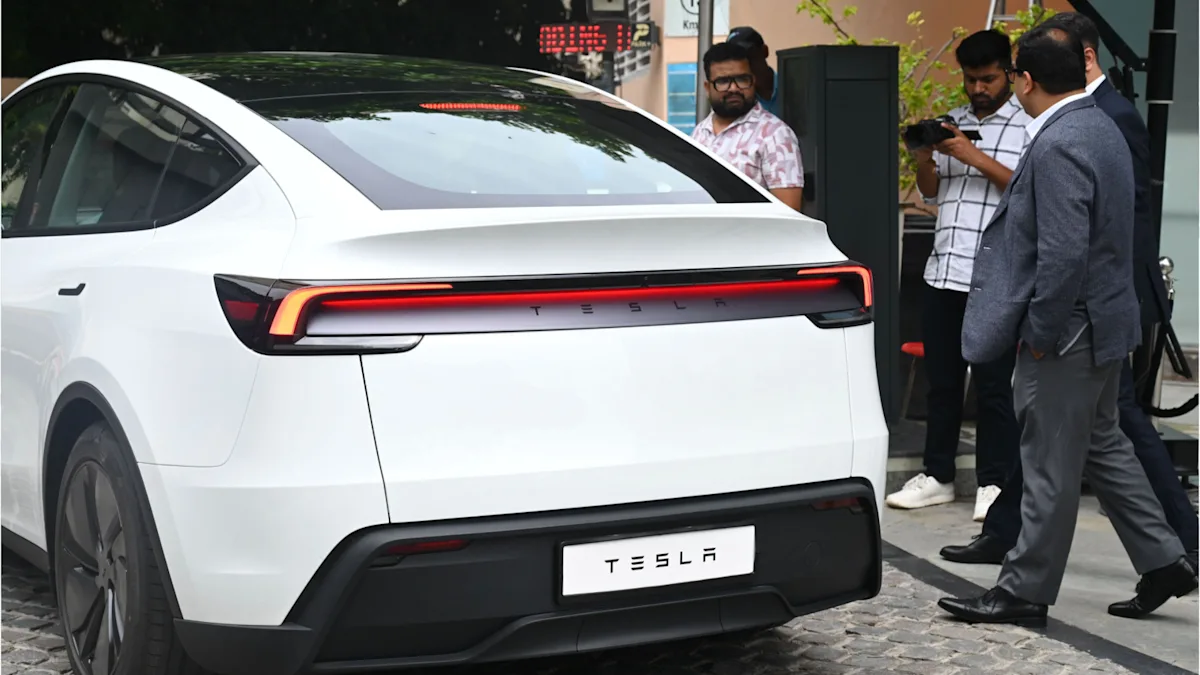
Tesla has chosen to deepen its presence in India with a move that looks far more ambitious than the company’s current sales figures suggest: the opening of its largest sales and service center in the country, located in Gurgaon. The decision lands at an uneasy moment for the EV maker – demand is sluggish, pricing is misaligned with the local market, and global headwinds are weighing on margins. As we note at YourDailyAnalysis, “India is not a market won by quarterly numbers; it rewards those willing to build the rails before running the train.”
The new facility – combining a showroom, service bay and charging station under one roof – is meant to signal commitment rather than celebrate scale. Behind the polished launch, however, the sales data paints a stark picture. Since Tesla’s arrival in July, just over 100 vehicles have been delivered, despite more than 600 reservations. Dealership data reviewed by BBC shows that only a small fraction of these bookings have converted into actual sales. Meanwhile, premium brands such as BMW, BYD and Mercedes-Benz are reporting strong numbers boosted by festive-season demand and broader tax incentives. At YourDailyAnalysis, we frame this contrast bluntly: “Tesla is not losing on product – it is losing on context. The company is applying U.S. logic to a market that follows entirely different rules.”
The biggest obstacle is taxation. With high import duties on fully built EVs, the Model Y lands in India at a price point dramatically above its U.S. equivalent. Despite government incentives encouraging local manufacturing, Tesla continues to rely on an import-heavy strategy – one that places every vehicle at the mercy of tariff structures. According to multiple reports, the company still prioritizes ecosystem building over production commitments, even as rivals benefit from local assembly.
This is where Tesla’s three-part recovery strategy begins: improving adoption through better visibility, expanding charging infrastructure nationwide, and elevating customer service. Sharad Agarwal, head of Tesla India, argues that owners can save up to two million rupees over four years on fuel and maintenance – roughly a third of the cost of a Model Y. Most maintenance is performed remotely through software updates, and home charging costs just a tenth of gasoline. These points resonate in a market sensitive to long-term cost of ownership, but the psychological barrier of a steep upfront price remains unchanged.
India’s EV ecosystem amplifies the challenge. Electric cars account for less than 3% of total passenger-vehicle sales, and public-charging expansion remains slow, with about 25,000 stations nationwide – far below the levels required for mass adoption. Tesla’s infrastructure push aims to narrow this gap: home charging can add around 70 km of range per hour, while the expanding Supercharger network delivers roughly 170 miles in 15 minutes. Yet adoption is constrained by both cost and grid reliability.
Tesla’s difficulties in India also intersect with a broader global slowdown. Despite posting a record quarterly revenue of $28 billion, the company’s profit fell 37% – pressured by higher tariffs, rising R&D spending and weakening demand in Europe, China and the U.S. This limits Tesla’s ability to aggressively adjust pricing in India without hurting margins elsewhere.
Stepping back, YourDailyAnalysis views Tesla’s India strategy as a long-term bet rather than a near-term growth lever. Opening the Gurgaon center is a statement of intent, but scaling will require more than infrastructure: local assembly, India-specific configurations and participation in government incentive schemes are essential if Tesla hopes to break out of the premium niche. For India, Tesla’s presence brings credibility to the EV transition; for investors, it offers a reminder that India is a slow-build market where infrastructure lays the foundation for future volume.
In our final assessment at Your Daily Analysis, Tesla’s path in India hinges on whether the company is willing to pivot from an import-based presence to genuine local integration. If it does, India could become a meaningful pillar of Tesla’s global portfolio. If not, the showroom in Gurgaon risks remaining a symbol of ambition rather than a gateway to scale.