


Early 2026 has delivered a notable divergence in global asset performance, with emerging market equities, currencies, and precious metals outperforming developed-market benchmarks. This shift reflects more than a short-term improvement in risk sentiment. It points to a broader reallocation process driven by dollar weakness, geopolitical friction, and growing discomfort with concentrated exposure to U.S. assets. From the perspective of YourDailyAnalysis, the current rally is best understood as a structural adjustment rather than a purely cyclical rebound.
Equity performance across emerging markets has remained consistently strong, with multi-week gains extending into early February. Outperformance relative to U.S. equities signals a change in portfolio construction, particularly among global investors seeking diversification away from dollar-denominated assets. While Asian technology stocks initially powered the advance, leadership has broadened, with Latin American equities delivering outsized gains. YourDailyAnalysis notes that this breadth reduces reliance on a single theme, but also introduces heterogeneity in risk drivers across regions.
Currency dynamics have reinforced this trend. The decision by Chinese authorities to tolerate a stronger daily reference level for the yuan marked a subtle but meaningful policy signal. It suggested greater confidence in external balances and a willingness to support capital inflows, improving sentiment across emerging Asia. At the same time, higher-yielding currencies in Latin America benefited from renewed carry demand as the dollar softened. These moves underline the sensitivity of emerging market assets to shifts in global monetary perception rather than purely domestic fundamentals.
Precious metals have emerged as a parallel beneficiary. Gold’s resilience near historic levels reflects a combination of portfolio hedging and sustained official-sector demand. Central banks in several regions continue to expand gold reserves as part of a longer-term diversification strategy, reinforcing the metal’s role beyond short-term speculation. YourDailyAnalysis views this as a reinforcing loop: reduced confidence in dollar stability increases demand for gold, which in turn strengthens the case for non-dollar asset allocation.
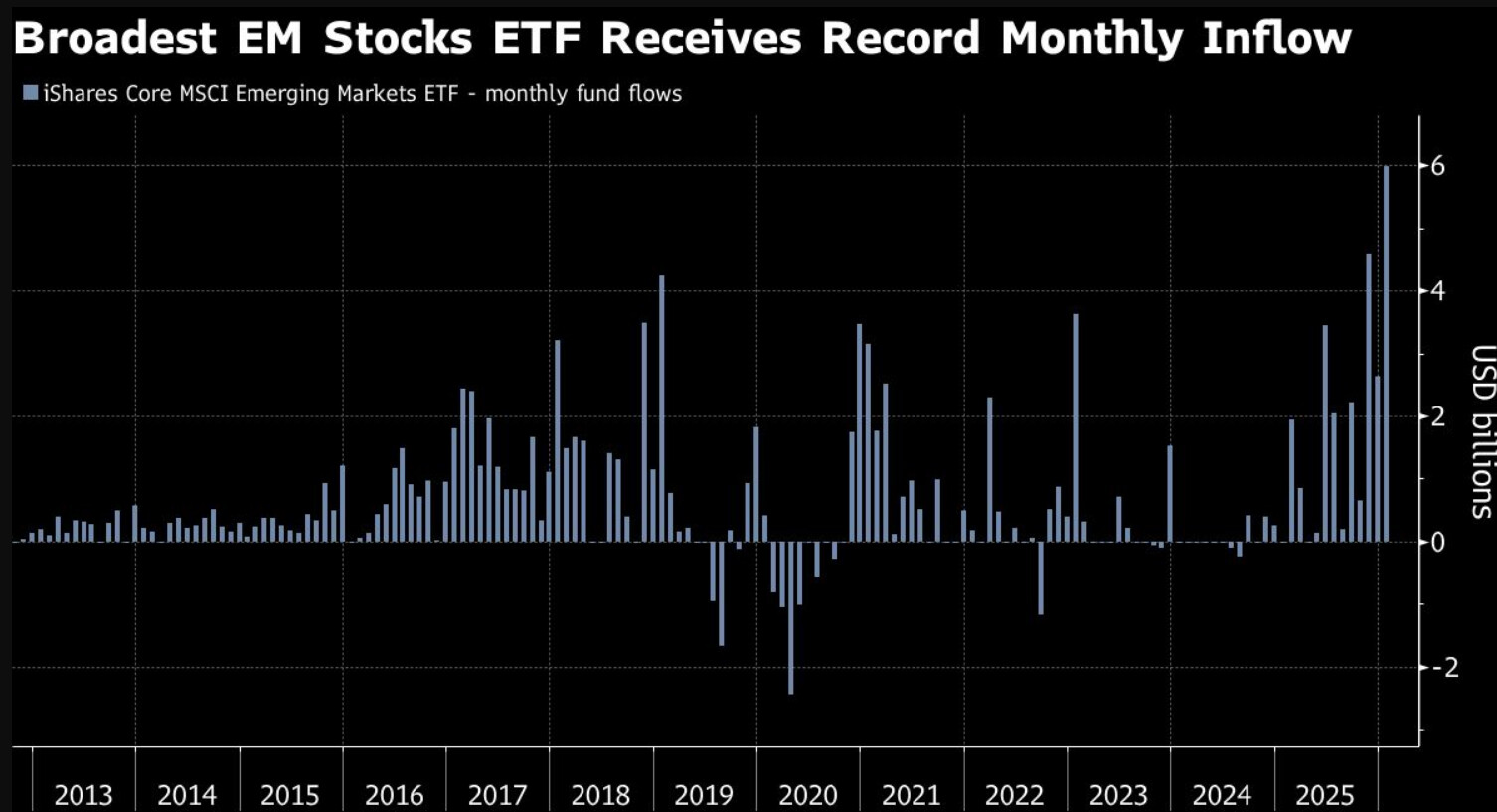
Capital flows provide further confirmation. Inflows into broad emerging market funds have accelerated at a pace rarely observed outside of major regime shifts. Large exchange-traded vehicles have attracted record monthly subscriptions, indicating institutional participation rather than retail-driven enthusiasm alone. While such inflows support prices in the near term, they also heighten vulnerability to sudden reversals should global conditions change.
Despite the positive momentum, structural constraints remain. The aggregate size and liquidity of emerging market assets are significantly smaller than those of U.S. markets. This asymmetry amplifies price movements in both directions. A modest reallocation away from U.S. bonds can materially lift emerging assets, but any resurgence in geopolitical stress or a sharp rebound in U.S. yields could trigger rapid outflows. Your Daily Analysis emphasizes that this liquidity profile demands disciplined risk management even within a constructive allocation framework.
The macro narrative supporting emerging markets is internally coherent: stable or orthodox policy settings in many economies, improving growth differentials, and diversification away from dollar-centric portfolios. However, the durability of this narrative depends on the absence of acute shocks. Markets are currently pricing gradual adjustment, not abrupt disruption.
As YourDailyAnalysis assesses the outlook, the emerging market rally appears supported by genuine allocation shifts, yet increasingly exposed to positioning risk. The balance of probabilities favors consolidation rather than uninterrupted gains. Investors engaging with this theme are likely to benefit most from selective exposure, regional differentiation, and an awareness that diversification-driven rallies tend to evolve in stages rather than move in straight lines.