


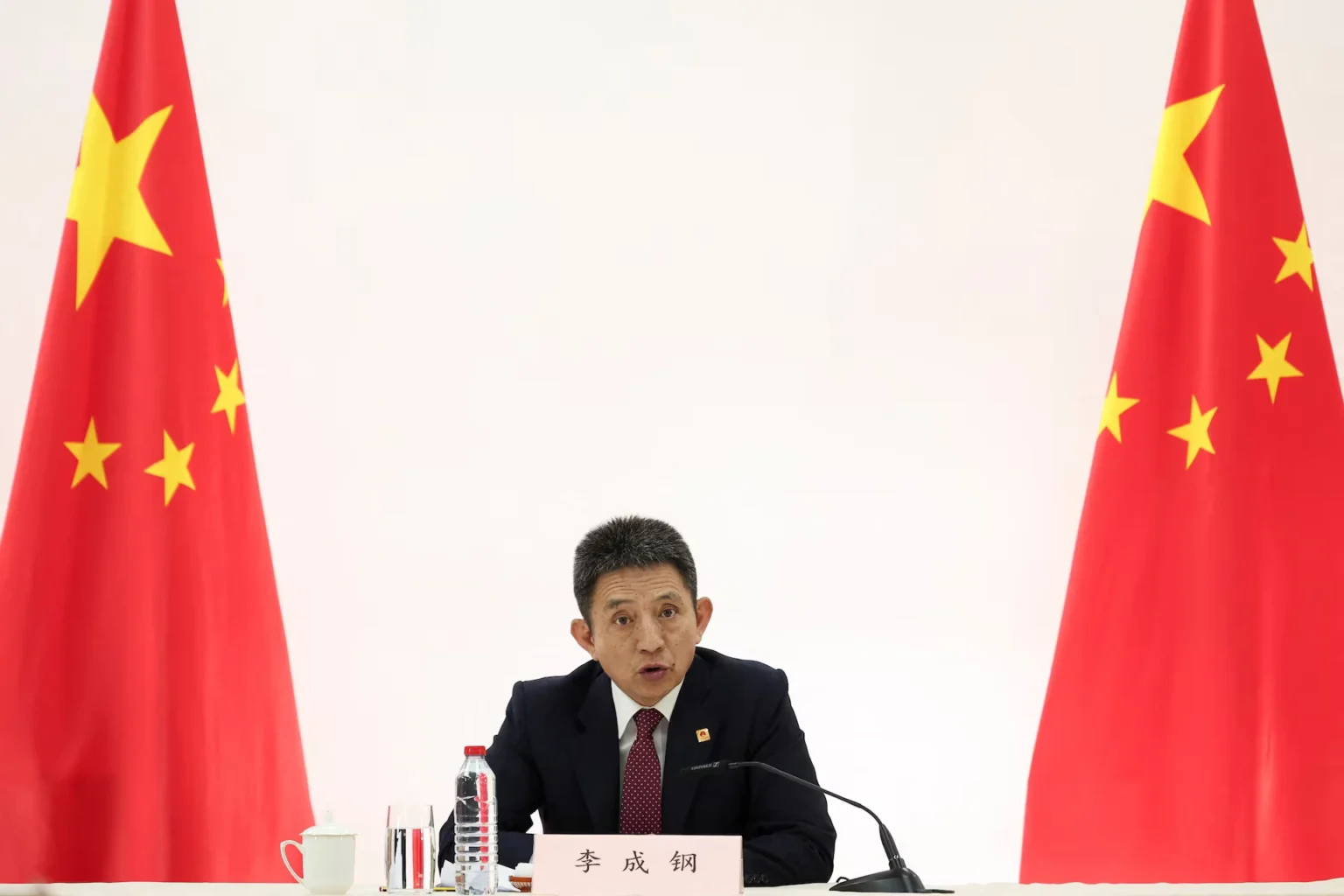
In the assessment of YourDailyAnalysis, the meeting between China’s vice minister of commerce Li Chenggang and Apple’s chief operating officer Sabih Khan is best understood not as a routine diplomatic courtesy, but as a calibrated signal aimed at stabilising expectations on both sides of an increasingly fragile U.S.–China technology corridor.
The official statement stressed familiar language – openness to foreign companies, expanded opportunities, and encouragement for deeper cooperation with local partners. In isolation, none of this is new. What matters is the timing and the level of the engagement. By engaging directly with Apple’s operational leadership rather than limiting contact to symbolic executive-level exchanges, Beijing appears focused on execution rather than optics: supply chains, partner alignment, compliance discipline, and long-term manufacturing continuity.
For China, Apple serves a dual purpose. It is both a critical anchor tenant in advanced manufacturing ecosystems and a global reference point used to demonstrate that foreign technology firms can still operate at scale inside China. Maintaining Apple’s confidence – even amid diversification away from China – helps Beijing counter the narrative of accelerated decoupling.
From Apple’s standpoint, the meeting reinforces a strategy that has become increasingly visible over the past two years: active risk management through regulatory dialogue. With geopolitical, trade, and compliance risks no longer abstract, direct engagement with economic policymakers functions as an insurance mechanism, buying predictability rather than preferential treatment.
Your Daily Analysis assesses that the message from Beijing is not one of liberalisation in the classical sense, but of conditional continuity. Market access remains available, but it is implicitly tied to deeper localisation, closer cooperation with domestic partners, and operational transparency. The emphasis on “developing the Chinese market” signals expectations of sustained commitment, not passive presence.
Looking ahead, the base case is neither confrontation nor meaningful thaw, but managed coexistence. Apple is likely to continue balancing incremental supply-chain diversification with sustained engagement in China, while Beijing uses structured dialogue to slow capital flight and preserve high-value industrial participation. For investors, the key signal to watch is not individual statements, but the cadence of such meetings. Regular, working-level engagement typically indicates an effort by both sides to contain downside risks rather than escalate them.
In sum, this encounter reflects a shared interest in preserving operational normalcy under deteriorating macro-political conditions – a pattern that, in our view at YourDailyAnalysis, is becoming the defining feature of global tech-state relations rather than the exception.