


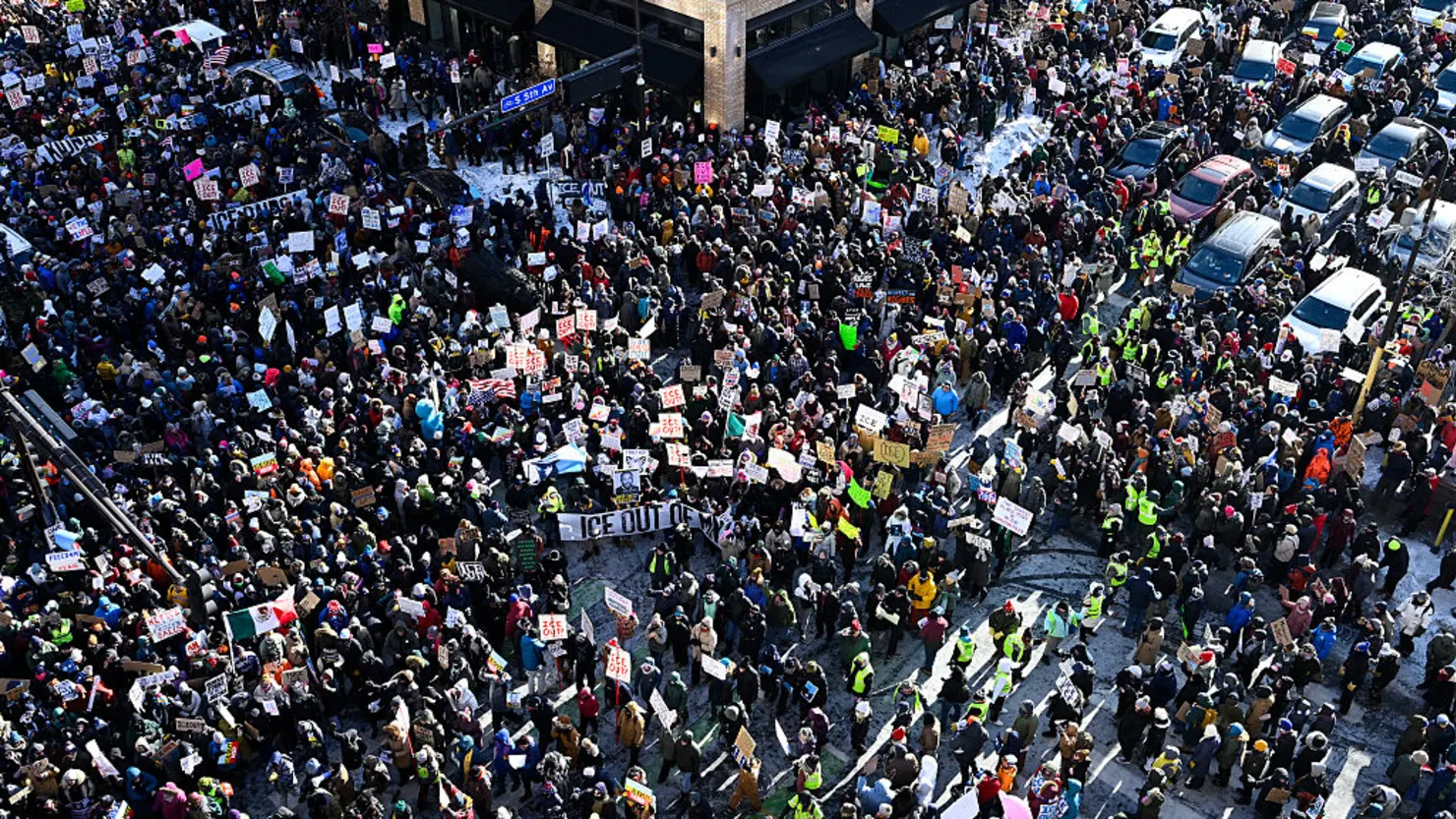
The fatal shooting involving federal immigration agents in Minnesota has forced a rare recalibration within U.S. corporate leadership. After months of near-total restraint as immigration enforcement expanded, business executives have begun to cautiously re-enter the public conversation – not out of ideological alignment, but because the operating environment has changed. From the perspective of YourDailyAnalysis, the episode highlights how political risk has become a domestic governance variable rather than an external policy concern.
For most of the past year, corporate leaders avoided public commentary on immigration enforcement, even as federal presence intensified in several U.S. cities. That silence reflected a rational calculation: the cost of dissent increasingly outweighed the perceived benefit. Legal pressure, regulatory scrutiny, and the threat of contract reviews have become credible deterrents, shifting executive behavior toward risk minimization rather than values signaling.
The response from Minnesota-based companies illustrates this shift clearly. Executives acted collectively rather than individually, issued language centered on “de-escalation,” and avoided naming specific actors, victims, or policies. This was not an absence of concern, but a deliberate form of risk distribution. YourDailyAnalysis interprets this as coalition-based speech designed to reduce exposure while still acknowledging internal and community pressure.
The underlying dynamic is structural. Political retaliation is no longer viewed as hypothetical. It is treated as a scenario to be modeled alongside regulatory change, litigation risk, and consumer backlash. As a result, corporate communication has migrated away from moral positioning toward procedural framing. De-escalation, safety, and institutional stability are defensible concepts; direct opposition is not.
The Minnesota case crossed a threshold because three factors aligned simultaneously. First, the event was highly visible and emotionally legible, leaving little room for ambiguity. Second, it occurred within a major corporate hub where employee and community proximity mattered. Third, internal impact became tangible, with firms acknowledging that employees had been directly affected by enforcement actions. When these conditions converge, silence becomes operationally costly.
Target’s response reflects this new equilibrium. During earlier national crises, the company took a public, values-driven stance. In the current environment, leadership opted for internal communication focused on employee well-being and legal clarity, while limiting external statements. From a YourDailyAnalysis standpoint, this is not inconsistency but adaptation. Companies now face dual exposure: public dissent risks federal retaliation, while silence risks erosion of internal trust and local legitimacy.
This tension is unlikely to resolve cleanly. Instead, several patterns are expected to define corporate behavior going forward. Public statements will increasingly be issued through groups rather than individuals. Messaging will emphasize process, safety, and stability rather than policy demands. Internally, companies will invest more heavily in employee communication to offset restrained public positioning.
For boards and senior management, the implications are practical. Political risk must be treated as a governance input, not a communications afterthought. Firms need predefined response frameworks that balance internal morale, community expectations, and external exposure. Improvised moral responses are giving way to structured risk management.
For investors, this shift matters. Companies with significant federal interfaces will behave differently from those with primarily consumer-facing exposure. These differences will surface in guidance tone, disclosure language, and long-term capital allocation decisions. Political stability, once assumed domestically, is now a variable influencing valuation.
From the perspective of Your Daily Analysis, the Minnesota episode is less about a single tragedy and more about a broader transition. Corporate America is learning to operate in an environment where political power is perceived as more personal, more reactive, and less predictable. In that environment, silence, speech, and structure all carry costs – and leadership is increasingly about choosing which risks can be absorbed, rather than which values can be declared.