



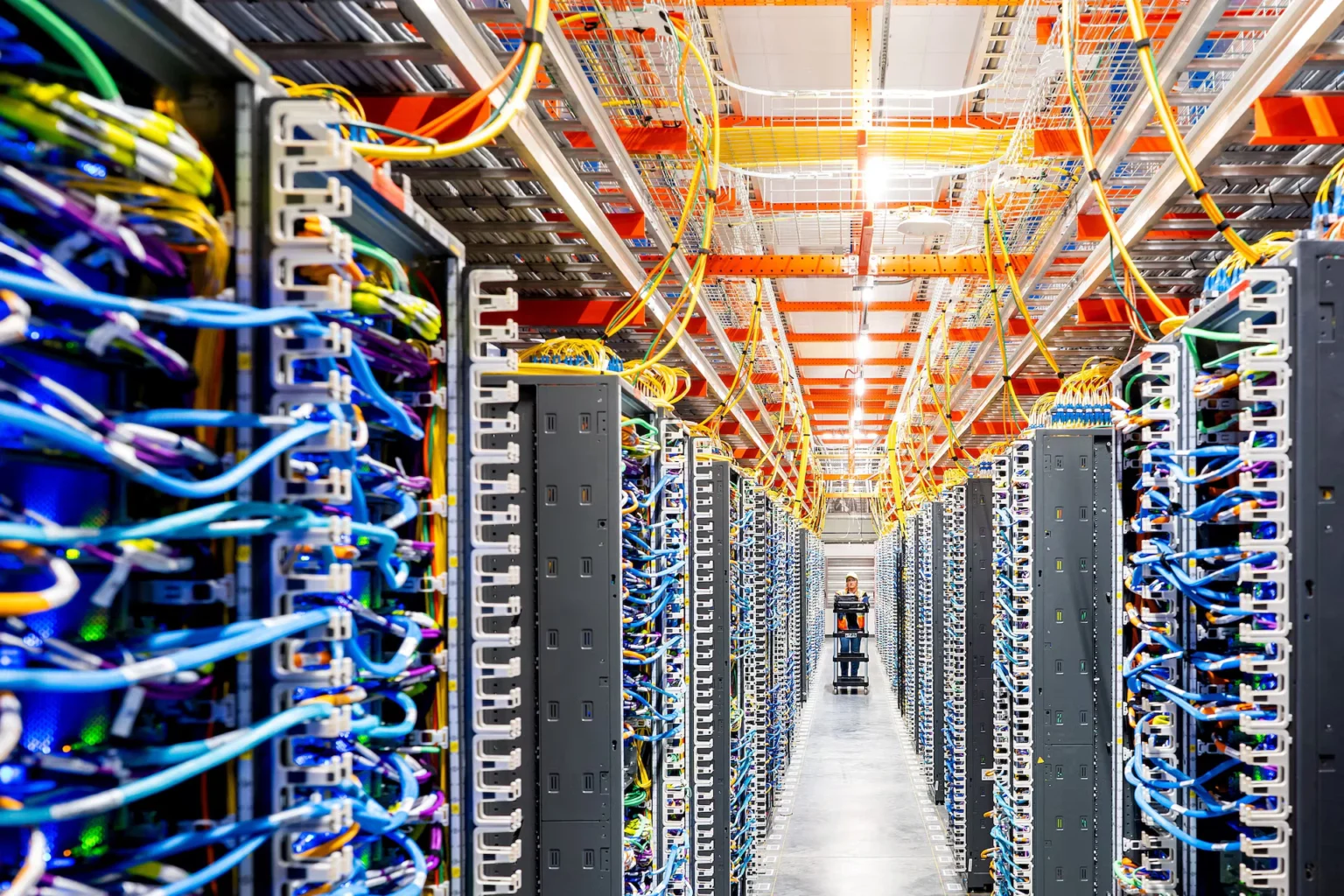
Long delays in connecting to power grids are emerging as a structural constraint on Europe’s data-center expansion, and Amazon’s experience is a clear illustration of how energy infrastructure is becoming the decisive bottleneck for the cloud and AI economy. In YourDailyAnalysis, this issue is not about a single company’s investment schedule but about Europe’s capacity to translate digital ambition into physical execution.
Amazon Web Services has made clear that grid connection timelines now play a critical role in determining where and when new data centers can be built. While large-scale data facilities can typically be constructed within two years, grid connections in several European countries can take up to seven years. From an analytical standpoint, this mismatch fundamentally alters investment risk profiles: when power availability lags construction by several years, capital efficiency, forecasting accuracy and regional competitiveness all deteriorate.
The comparison with the United States is instructive. Although grid backlogs there can also stretch for years in congested regions, average connection times are generally shorter. YourDailyAnalysis interprets this gap not as a technical inevitability, but as a governance problem. Europe’s challenge lies less in generation capacity and more in permitting, queue management and the speed at which transmission upgrades move from planning to delivery.
A key distortion comes from speculative grid applications. In countries such as Italy and Spain, large volumes of connection requests were filed as placeholders, occupying capacity that may never be used. Because queues operate on a strict first-come, first-served basis, viable industrial and digital projects are often blocked behind dormant claims. In YourDailyAnalysis, this is one of the most actionable failure points: tightening entry requirements and enforcing project-readiness thresholds could unlock capacity faster than years of new construction.
Regulatory reform is underway, with the European Commission proposing to cap grid permitting timelines at two years and ease certain environmental approval requirements. These steps signal a shift toward treating electricity networks as strategic infrastructure rather than routine public works. Still, from an analytical perspective, legislation alone will not solve the delivery problem. Grid reinforcement remains constrained by equipment shortages, skilled-labor bottlenecks and fragmented national implementation.
Financing is the next pressure layer. Europe’s grid investment needs are already measured in the hundreds of billions of euros through the end of the decade, and transmission operators have warned that current funding plans fall short. Your Daily Analysis sees an emerging model in which large, creditworthy electricity consumers – including hyperscalers, EV-charging networks and industrial clusters – increasingly co-invest in grid upgrades to secure predictable access and timelines.
For Amazon and its peers, this reality reshapes site-selection logic. Grid certainty is becoming as important as tax incentives or real-estate availability. Projects will increasingly concentrate in regions with disciplined queue management, transparent permitting and credible upgrade schedules. For policymakers, the implication is blunt: without faster grid delivery, Europe risks losing digital infrastructure growth not because of weak demand, but because electrons cannot arrive on time.
The broader conclusion in YourDailyAnalysis is that power networks have become the hidden governor on Europe’s AI and cloud ambitions. Fixing grid queues, accelerating permitting and scaling investment are no longer energy-policy side issues – they are prerequisites for competitiveness. If Europe fails to align its energy timelines with its digital aspirations, data-center expansion will continue to be shaped by calendars rather than capital.