


South Korea is no longer trying to catch up in the global AI race – it is attempting to rewrite its trajectory entirely. When the Ministry of Industry and Arm, the SoftBank-owned chip architecture leader, announced a partnership to establish a semiconductor design school, it became clear that Seoul is laying the intellectual foundation of its AI era. At YourDailyAnalysis, we see this not as an educational initiative but as a strategic effort to rebuild the country’s semiconductor architecture, long dominated by memory production yet lacking depth in system design and higher-value IP.
Arm plans to train around 1,400 next-generation chip designers – specialists capable of working with architectures that will define future AI computation. This marks a critical shift: in today’s semiconductor industry, the bottleneck is no longer manufacturing capacity, but talent. South Korea excels in producing world-class HBM memory, but true strategic leverage lies in owning the intellectual layers of the stack – design, architecture and proprietary IP. From our perspective at YourDailyAnalysis, this school lays groundwork for a new wave of Korean fabless companies capable of competing not only in Asia but globally.
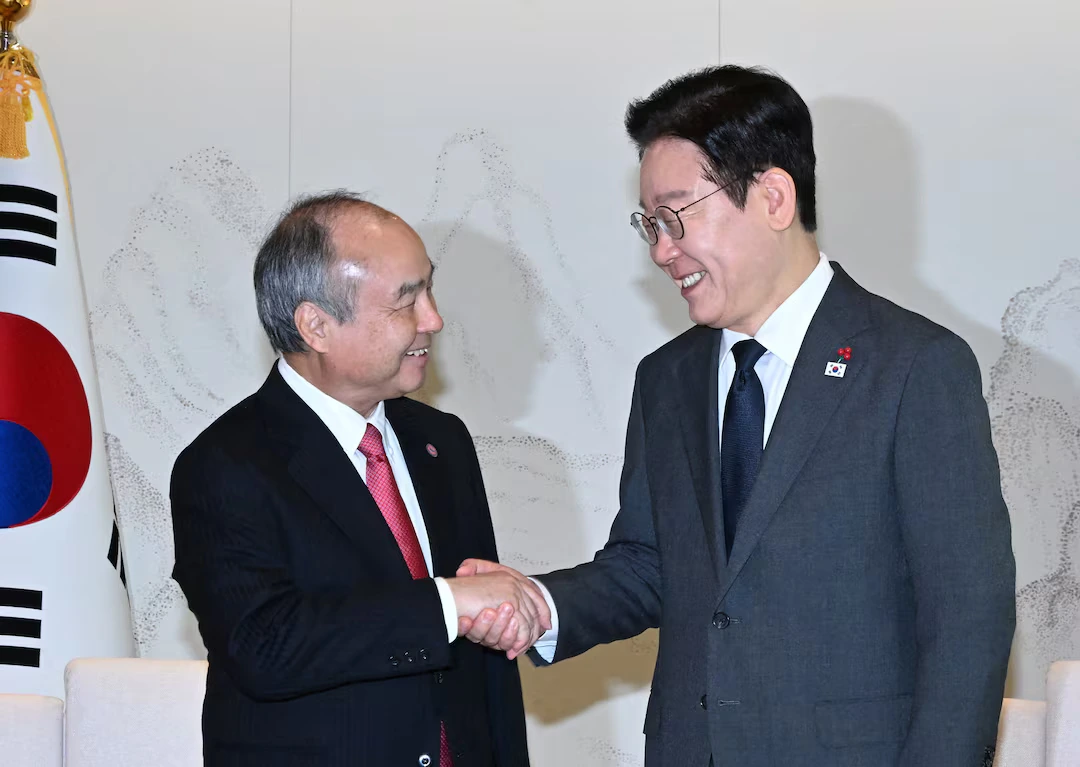
Masayoshi Son’s visit elevated the significance of the deal. The SoftBank founder reiterated that demand for chips will surge dramatically and that AI development is turning semiconductors into the scarcest resource of the technological age. His warning about Korea’s insufficient energy capacity is less criticism than a strategic caution: AI supercomputers and data factories demand not only chips but resilient power systems. In the view of YourDailyAnalysis, this signals that Korea’s semiconductor strategy will inevitably become an energy strategy as well – without it, infrastructure will buckle under the weight of AI ambitions.
The country is already weaving a global network of alliances: Samsung and SK Hynix have agreed to supply memory for OpenAI’s data centers, while the Stargate initiative effectively positions Korea as a central node in the world’s AI infrastructure. Nvidia’s commitment to deliver more than 260,000 advanced AI chips to Korean companies and the government transforms the country into a proving ground for next-generation AI services. These aren’t merely shipments; they advance a technological interdependence that gives Korea leverage while simultaneously anchoring it within the American AI ecosystem.
President Lee’s meetings with Sam Altman, Jensen Huang and Korea’s largest conglomerates reinforce this trajectory. The government’s ambition to become one of the world’s top three AI powers is no longer rhetorical – it is being built through talent pipelines, supply agreements and geopolitical partnerships. As YourDailyAnalysis observes, South Korea is moving deliberately from being a “memory superpower” to becoming a full AI innovation hub, with its own talent, IP and scalable infrastructure.
This creates a new reality: Korea is no longer playing the role of supplier but attempting to act as a strategist. Yet its success will depend on whether the country can modernize its energy system, maintain access to global AI technology and cultivate a domestic talent base strong enough to generate independent innovation. In the assessment of Your Daily Analysis, these three factors will determine whether Korea’s current momentum becomes the foundation of a new technological cycle – or just a brief, bright chapter in the global AI rush.