



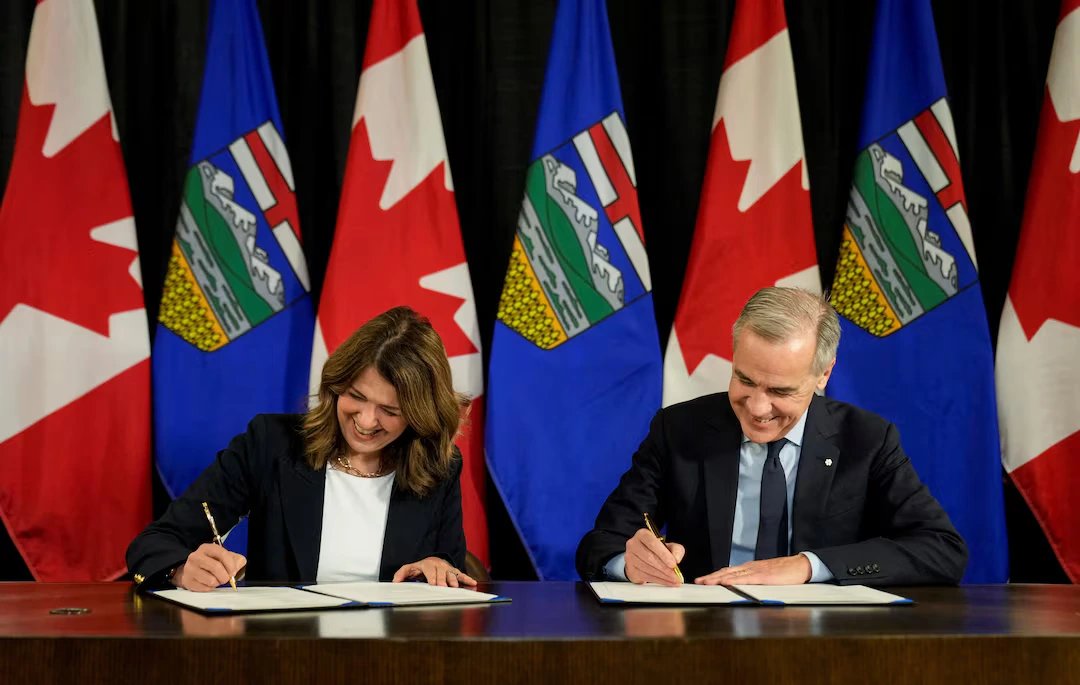
Canada’s political landscape shifted abruptly this week as Prime Minister Mark Carney signed a sweeping agreement with Alberta that revives a long-controversial vision: a pipeline carrying Canadian oil to the Pacific. For years the project existed more as a political mirage than a real proposal, stalled by environmental concerns, provincial tensions and federal climate laws. As we at YourDailyAnalysis observe, Carney’s decision marks both a strategy for economic diversification and a test of how far Canada is willing to stretch its climate commitments in the name of market access.
The agreement grants Alberta’s proposed pipeline exemptions from key federal climate regulations. In exchange, the province must raise its carbon pricing and build what would become the world’s largest carbon-capture program – a monumental undertaking meant to offset the emissions associated with new oil infrastructure. For Alberta, the deal is a long-awaited reopening of doors. Premier Danielle Smith called it “the end of dark times,” arguing the province had been held back from developing the resources that underpin its economy.
Carney, for his part, presents the project as a national necessity. With over 90% of Canadian crude currently flowing to the United States, the prime minister is betting that new access to Asian markets will make Canada less vulnerable to the shifting trade barriers and protectionist tariffs Washington has imposed in recent years. As YourDailyAnalysis notes, Carney’s core logic is clear: economic security demands export diversification.
But the political cost surfaced almost instantly. Hours after the announcement, cabinet minister Steven Guilbeault – a former Greenpeace activist and one of the architects of Canada’s climate agenda – resigned in protest. Guilbeault warned the pipeline would cause significant environmental harm and accused the government of unraveling key policies he had introduced during his tenure as environment minister. His exit signals more than ideological disagreement; it’s the first major crack in the unity of Carney’s cabinet.
The backlash from British Columbia adds another layer of complexity. Premier David Eby criticized the process itself, saying BC was excluded from negotiations despite being the province through which the pipeline must pass to reach the Pacific. He emphasized the absence of a private-sector sponsor and the lack of Indigenous community support – two factors that have derailed multiple Canadian pipeline projects in the past. Eby warned the proposal could undermine support for BC’s own LNG developments and called it an “energy vampire” until proven otherwise.
Indigenous leaders on the BC coast were even more explicit, issuing a joint statement declaring that a northern pipeline route “will never be built.” As we note at YourDailyAnalysis, such declarations in Canadian politics rarely soften with time; they typically translate into regulatory challenges, court actions and lengthy delays that can extend beyond a decade.
Meanwhile, Alberta has pledged C$14 million to advance the proposal, hoping it will later attract private investment. But without a defined route, Indigenous partnerships or a committed corporate backer, the project remains at the earliest conceptual stage.
Carney insists the effort is essential if Canada wants to double its non-U.S. crude exports within the next decade. Yet the opposition sees the announcement as political theater. Conservative leader Pierre Poilievre dismissed the agreement as a symbolic starting point that guarantees nothing, pointing out that Carney once promised “unimaginable speed” on key files and has yet to deliver it here.
BC’s concerns highlight deeper risks: the pipeline could disrupt the province’s climate agenda, fracture agreements with First Nations and compete with LNG infrastructure still dependent on community approval. Without BC, the route to the Pacific is simply closed.
At YourDailyAnalysis, we view the conflict as more than a policy dispute. It is a collision between two visions of Canada’s future – Alberta’s energy pragmatism and British Columbia’s climate-driven governance – with Carney attempting to bridge a divide that has widened for more than a decade. It is also a reminder that Canada’s federal structure is increasingly shaped by regional power, where national ambitions can falter without provincial endorsement.
In closing, Your Daily Analysis believes the pipeline’s fate will hinge on a three-sided equation: British Columbia’s willingness to engage, Indigenous communities’ consent, and the private sector’s appetite for risk. Without all three, the project remains aspirational. Investors should prepare for prolonged regulatory volatility, provinces must brace for renegotiated authority lines, and Carney will need political dexterity beyond what this initial memorandum displays. The pipeline could redefine Canada’s next decade – or stand as a symbol of ambition constrained by political, environmental and social realities.