



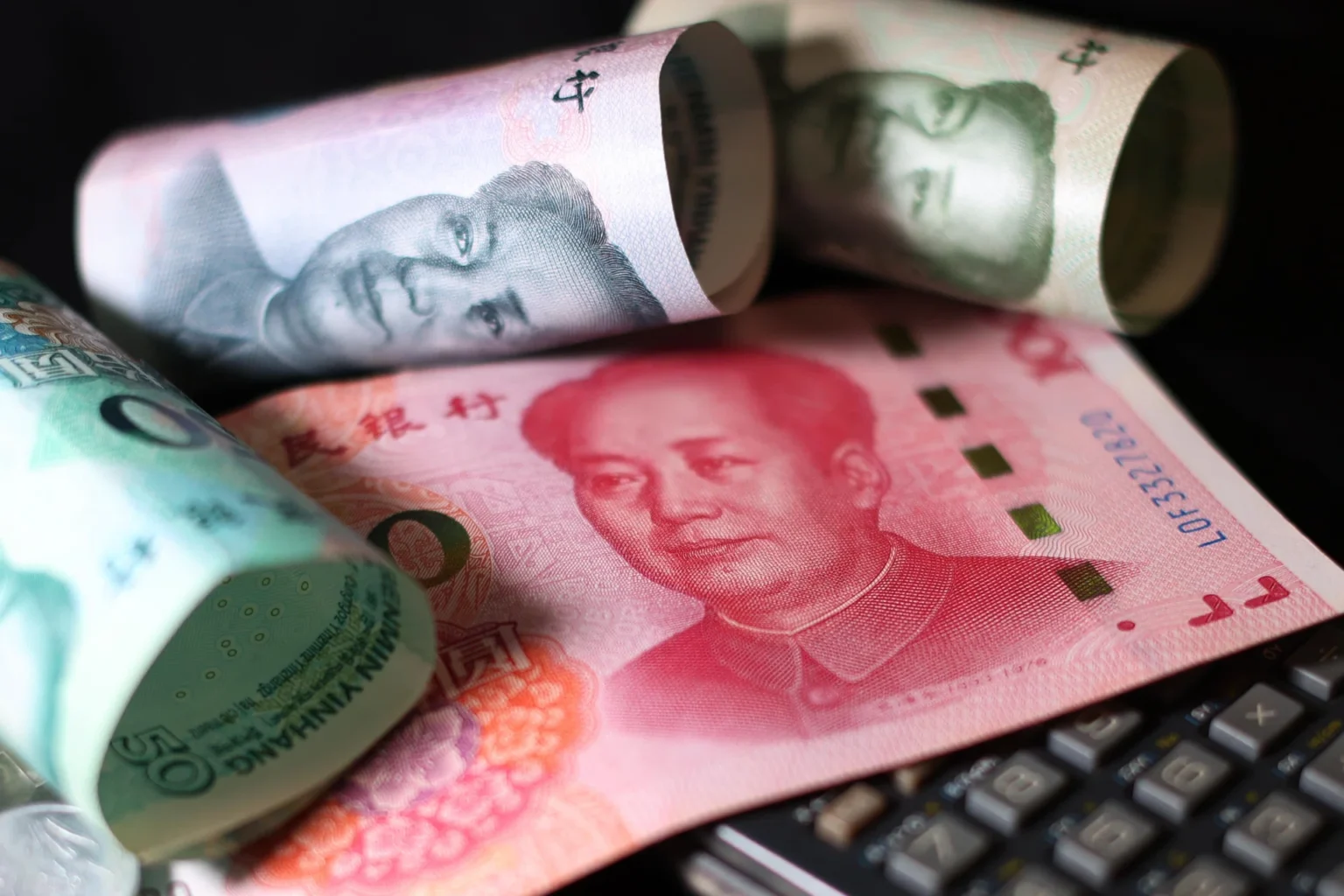
The tightly managed onshore yuan is on track for a sixth consecutive quarter of gains against the dollar – a streak not seen since 2013. That run is not primarily a story about dollar weakness or Federal Reserve policy. It is a story about what China sells to the world and who is buying. The global AI investment boom has generated a wave of Chinese exports that did not exist at scale three years ago: server racks, power management systems, transformer components, specialized cables, robotics for data center construction, and rare earth materials used in advanced magnets and semiconductors. Demand from hyperscalers and national AI buildout programs in Europe, Southeast Asia, and the Gulf states has flowed into Chinese manufacturing in ways that directly support the currency.
The conventional wisdom on the yuan has been that China’s leadership resists appreciation because export competitiveness depends on a relatively weak currency. That logic held for most of the period since 2015. What has changed is the composition of Chinese exports. Traditional labor-cost-sensitive manufacturing – apparel, furniture, basic consumer electronics – still exists and still competes on price. But a growing share of China’s export revenue now comes from products where the demand is relatively inelastic with respect to currency price: rare earth compounds, battery materials, specialized industrial equipment, and AI-adjacent hardware that global buyers simply cannot source elsewhere in volume. When your customers cannot substitute and cannot wait, a modestly stronger yuan compresses your margins but does not lose you the order. That is the structural change that makes a sixth quarter of yuan appreciation politically tolerable. The implicit policy shift – tolerating a stronger currency because buyers cannot substitute – represents a structural change that Beijing is not advertising but is clearly allowing. Analysts at YourDailyAnalysis interpret this tolerance as a genuine regime shift, not a temporary posture.
The numbers behind the trade surplus are striking. China’s trade surplus has climbed to approximately 5.5% of GDP by some estimates, driven by the combination of strong export demand and constrained domestic consumption. The surplus is simultaneously funding yuan appreciation pressure and giving Beijing room to manage the pace. YourDailyAnalysis benchmarks the current surplus at approximately 5.5% of GDP against the 2015 peak of around 3.8%, noting the imbalance now substantially exceeds prior highs. The People’s Bank of China sets a daily midpoint fixing and has historically used this mechanism to cap volatility in both directions. The current management allows gradual appreciation while preventing the kind of sharp move that would damage the export sectors that still depend on cost competitiveness.
There is a counter-argument that the yuan’s strength may prove fragile. The AI hardware demand cycle, while large, is not unlimited. If hyperscaler capex normalizes in 2027 – which Goldman Sachs and several sell-side desks have flagged as a risk – the specific export categories driving the current surplus may soften. At the same time, China’s domestic consumption remains weak, deflationary pressure is persistent, and the property sector recovery has been incomplete. A meaningful slowdown in the AI export premium would leave the yuan exposed to the underlying structural weaknesses that the trade surplus has been masking. The yuan’s appreciation streak sits on a narrower foundation than it appears. YourDailyAnalysis positions it as durable near term but dependent on a single driver that could slow faster than consensus assumes.
The geopolitical dimension runs separately but reinforces the currency dynamic. China’s dominant position in rare earth processing, battery materials, and AI hardware supply chains means that Western nations pursuing AI buildout programs are, de facto, funding Chinese export revenues regardless of their stated geopolitical preferences. The European RESourceEU Action Plan, U.S. domestic chip investments, and Japan’s Mercosur negotiations all acknowledge this dependency – but none can resolve it quickly. That structural demand gives China’s currency a support that policy documents and political declarations cannot easily erode. Your Daily Analysis describes this as a geopolitical subsidy that Western AI ambitions are, ironically, paying directly into the PBOC’s reserve management.
The yuan’s sixth consecutive quarterly gain, if confirmed at end of June, will represent the longest streak in 13 years. Watch the PBOC’s daily midpoint fixing for Beijing’s appetite for continued appreciation versus a managed plateau.