


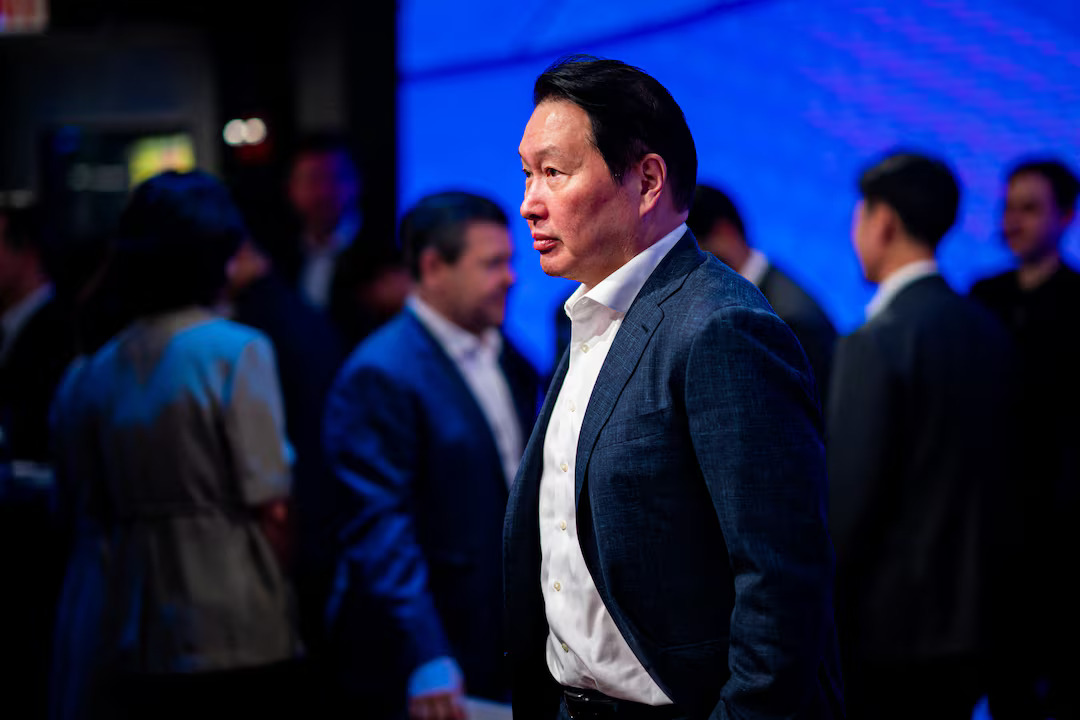
When South Korean billionaire Chey Tae-won attends Friday’s bell-ringing ceremony for SK Hynix’s $26.5 billion Nasdaq listing, it will mark the payoff of a bet many once considered reckless: buying a loss-making chipmaker that has since become an AI powerhouse. SK Group’s 2012 acquisition of Hynix was viewed as problematic even inside the conglomerate – memory chips are cyclical and capital-intensive, and the company was losing money while trailing Samsung Electronics in both market share and technology. YourDailyAnalysis flags that internal skepticism as the detail that makes this listing more than a routine capital-markets milestone: Chey was overriding doubts from within his own organization, not just market consensus.
The specific technical bet that paid off is worth isolating. Under Chey, seeking an edge over Samsung, SK Hynix spent more than a decade wagering on high-bandwidth memory chips, at the time a niche technology with no guaranteed commercial application. That wager paid off once HBM became a critical component in Nvidia’s AI accelerators, helping SK Hynix emerge as the world’s largest producer of the chip. “SK is our largest memory partner. Without SK’s partnership, today’s AI industry would not have developed as wonderfully as it has,” Nvidia CEO Jensen Huang told reporters in Seoul in June, with Chey standing beside him.
The execution credit, according to people close to the company, belongs less to top-down conglomerate strategy than to a specific internal choice about personnel. Kim Dae-il, a former SK Hynix board member and economics professor at Seoul National University, said Chey promoted executives from within Hynix rather than bringing in managers from the broader SK Group, and credited Park Sung-wook, a longtime chip engineer appointed CEO in 2013, with refusing to abandon HBM even amid boardroom skepticism. “Ultimately, Chairman Chey’s achievement was making the right bets and putting the right people in place,” Kim said. YourDailyAnalysis treats that framing as important context for how concentrated this success actually was: it depended on a small number of specific personnel decisions holding firm against internal doubt, not on an inevitable macro trend that any operator would have captured.
The current picture isn’t unambiguous triumph, however – Chey himself is flagging risk even from inside the boom. “We are facing a shortage of memory supply, which in some ways is a welcome problem for me,” he said in an April speech. “People may say, ‘Isn’t it good because you’re making a lot of money?’ But this situation cannot last forever.” Both SK Hynix and Samsung have since pledged hundreds of billions of dollars in new South Korean chip plants, following President Lee Jae Myung’s call for measures to narrow regional economic divides – expansion plans that have themselves raised concerns about potential oversupply in a historically cyclical industry.
Chey’s personal financial exposure to this listing is more indirect than it might appear. He is not a direct shareholder of SK Hynix; instead, he is the largest shareholder of SK Inc, which holds a 32% stake in SK Hynix’s top shareholder, SK Square. His personal wealth is estimated at $5.4 billion by Forbes. Your Daily Analysis notes that layered ownership structure is fairly typical of how South Korean chaebol control works – Chey’s influence over SK Hynix’s strategic direction has always run through governance and personnel rather than through a controlling equity stake in the operating company itself.
Chey’s public profile has been shaped by more than business results. In 2015 he wrote a letter to a local newspaper publicly admitting he had become estranged from his then-wife and had a child with another woman, an unusually candid disclosure for a Korean chaebol leader that divided public opinion in a society where extramarital relationships remain deeply stigmatized. He’s now in an acrimonious divorce settlement lawsuit with hundreds of millions of dollars at stake, a case that could affect ownership of South Korea’s second-largest conglomerate after Samsung Group. He also spent more than two years in prison for embezzling corporate funds before receiving a presidential pardon in 2015, when the government said freeing Chey and other business leaders was intended to help develop the country’s economy.
Watch how SK Hynix’s Nasdaq shares trade in their first sessions relative to the pricing that made this the largest-ever US first-time share sale by a foreign company, and watch whether the expansion pledges from both SK Hynix and Samsung start to show up as concrete oversupply concerns in memory pricing over the coming quarters. YourDailyAnalysis views Chey’s own April warning about unsustainable memory shortages as the more forward-looking signal here – the person who built this bet is already flagging that the conditions making it so lucrative right now won’t hold indefinitely.