

Source: https://finance.yahoo.com/technology/ai/articles/xi-vows-ai-debut-china-024305898.html
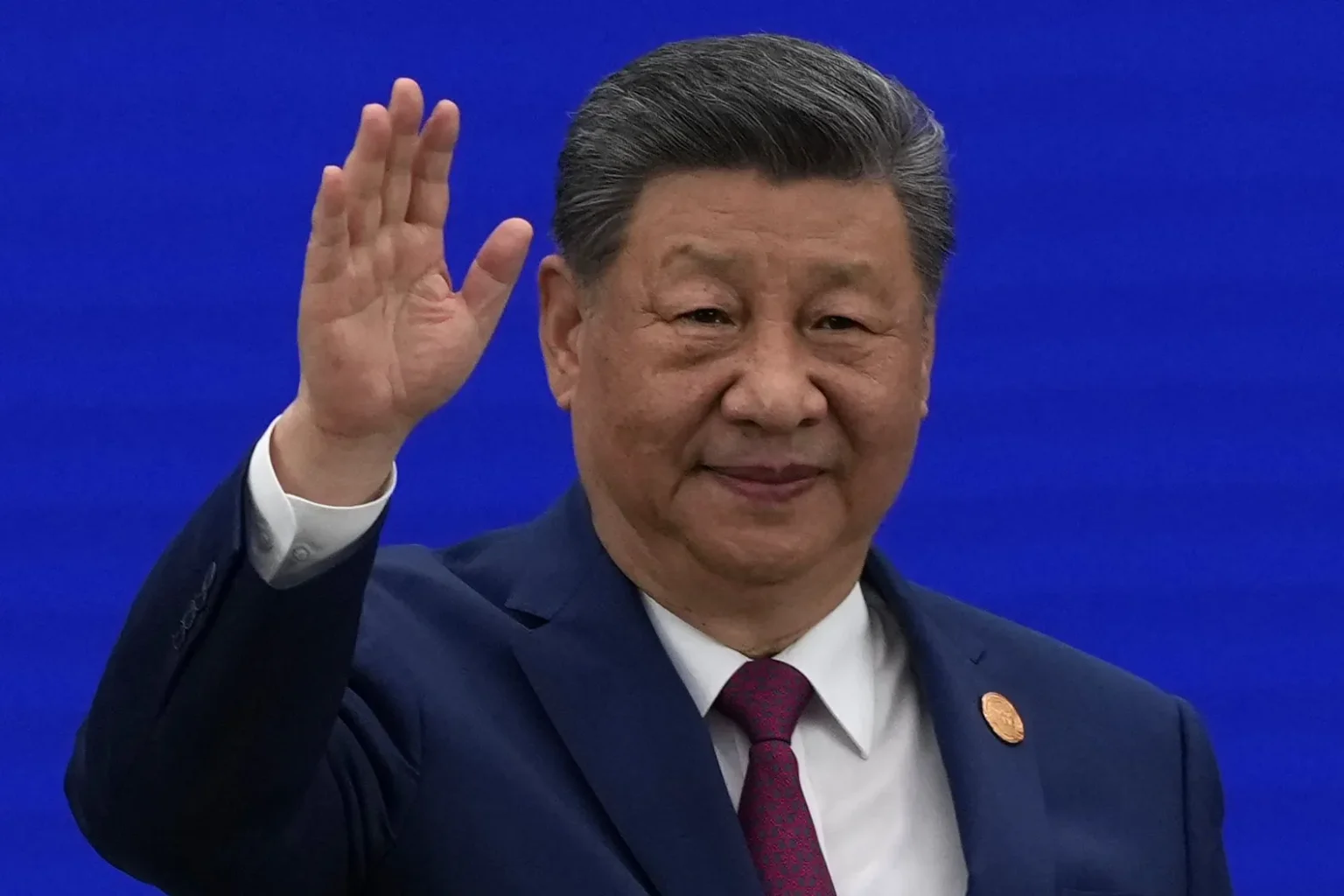
President Xi Jinping hailed China’s progress in developing low-cost artificial intelligence at his first appearance at the World AI Conference in Shanghai on Friday, pressing his personal imprint on the country’s rapidly expanding global influence to call for a more open technological order. “AI development should not be a solo performance by a single country, but a symphony of international cooperation,” he said, urging attendees to adhere to an inclusive approach that encourages collaboration without rivalries. YourDailyAnalysis flags the significance of this being Xi’s debut at the event specifically: a first-ever personal appearance at China’s top AI gathering is a deliberate elevation of the technology’s political priority, not a routine diplomatic courtesy.
The commercial backdrop gives Xi’s cooperative rhetoric real substance rather than leaving it as pure diplomacy. Chinese models are winning over companies worldwide, with their share of U.S. firms’ AI usage nearing a record 60% on the popular marketplace OpenRouter. YourDailyAnalysis treats that 60% figure as the concrete evidence underlying Xi’s “low-cost AI” framing: Chinese models aren’t just competitive in domestic or price-sensitive emerging markets, they’re winning meaningful share directly inside the U.S. commercial AI ecosystem, which is a far stronger validation of China’s technology than official statistics alone would provide.
Behind that public rhetoric of openness, Beijing is quietly moving in a more restrictive direction on its own most capable models. Chinese officials recently discussed with companies including Alibaba, developer of the popular Qwen models, how to mitigate security risks posed by their increasingly powerful models; the talks are early with no enforcement planned, but restricting foreign access to top models was among the options raised, according to people familiar with the matter. Reuters had previously reported Beijing was weighing curbs on overseas access. YourDailyAnalysis reads that direct tension – Xi publicly calling for international cooperation while his own officials discuss restricting foreign access to China’s leading models – as the real story beneath the summit’s diplomatic language, and a dynamic mirroring Washington’s own posture toward labs like Anthropic.
That mirrored dynamic is explicit and mutual. With the cybersecurity threat of cutting-edge AI looming over both countries, Washington has in recent weeks pressured prominent American labs such as Anthropic to curtail foreign access to advanced models – meaning both superpowers are simultaneously talking publicly about open, cooperative AI development while privately tightening control over their own most capable systems, a contradiction that appears structural to the current moment in the AI race rather than specific to either government.
China’s stated strategy is explicitly about building parallel infrastructure and reducing American dependency, not just matching capability. Beijing has earmarked 2 trillion yuan over the next five years to create a network of inter-connected data centers across the country, aiming to secure its own AI supply chain that guarantees access for Chinese companies and government agencies while offering global customers a cheaper alternative to U.S. technology. Even that ambitious commitment, roughly $280 billion over five years at current exchange rates, pales next to the $725 billion that U.S. companies including Meta and Microsoft are setting aside for AI this year alone – China’s cost advantage in construction and labor narrows but doesn’t erase that gap.
The strategy relies on a specific roster of national champions carrying the weight of this effort, continuing a pattern set by prior technology pushes. Beijing’s plan relies on the sustained growth of national champions including Nvidia rival Huawei Technologies, memory-chip linchpin CXMT, and pioneering labs such as DeepSeek, recalling the resource-channeling approach of years past that supported champions like Huawei with the explicit aim of replacing U.S. technology. That’s the same CXMT whose $8.6 billion Shanghai IPO drew retail frenzy this week, and the same DeepSeek reportedly developing its own inference chip – both companies functioning as concrete instruments of the state-level strategy Xi articulated in Shanghai.
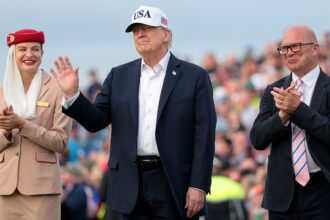
Watch for any formal announcement on the foreign-access restrictions Chinese officials have been discussing with Alibaba and other model developers, since a concrete policy would directly contradict the “symphony of international cooperation” framing Xi used at the summit. Your Daily Analysis views the September meeting between Xi and Trump, where the AI race is reportedly top of the agenda, as the more consequential near-term event for how these parallel dynamics of public cooperation rhetoric and private access restriction ultimately get reconciled, or don’t, between the world’s two AI superpowers.