



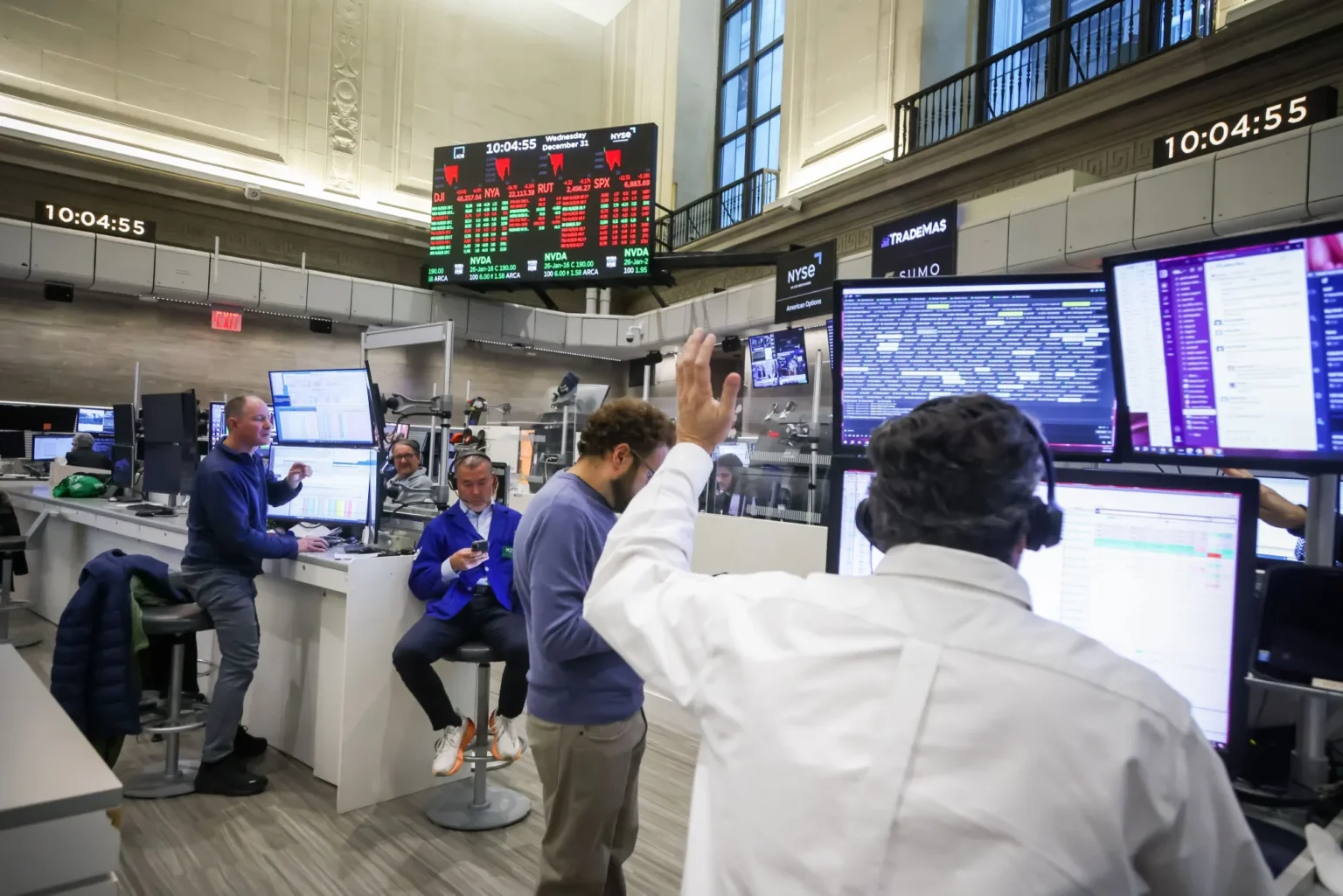
Daily market action on Wall Street is increasingly defined by sharp swings between crowded risk positions and abrupt retreats into defensive assets. The latest episode reflects not a single shock, but a cumulative reassessment of valuations that had already stretched far ahead of underlying certainty. In YourDailyAnalysis, this pattern is best understood as a slow-motion confidence reset rather than a discrete panic event.
Equity markets offered a clear signal. The S&P 500 recorded its third consecutive daily decline, while the Nasdaq 100 moved toward its deepest pullback since April, led by renewed weakness in software and high-multiple technology names. The immediate catalyst was the unveiling of a new artificial intelligence model by a leading AI startup, highlighting competitive pressure on software business models that had previously been viewed as insulated beneficiaries of the AI boom. In YourDailyAnalysis, this marks a shift in perception: artificial intelligence is no longer priced solely as a growth accelerator, but increasingly as a source of disruption for incumbent revenue structures.
The selloff extended well beyond equities. Silver, which had tracked gold to record highs, suffered a steep reversal, while bitcoin erased a large portion of gains accumulated since the U.S. election cycle, as leveraged positions were unwound. The synchronised decline across speculative and defensive assets underscores a broader theme identified by YourDailyAnalysis: positioning, rather than fundamentals, had become the dominant driver of price action. Once confidence faltered, liquidity conditions amplified moves across markets.
Government bonds, by contrast, resumed their traditional role as a stabilising force. Demand for U.S. Treasuries increased as investors sought duration exposure amid rising uncertainty, reinforcing the view that conventional safe havens remain relevant when risk assets reprice rapidly. This divergence between bonds and alternative hedges is analytically significant. In YourDailyAnalysis, it reflects persistent doubts about the ability of crypto assets to function as crisis hedges during periods of geopolitical or macroeconomic stress.
Corporate guidance further contributed to the reassessment. After the close, a major technology platform disclosed plans for capital expenditures well above market expectations, intensifying concerns that the industry may be overspending on artificial intelligence infrastructure before clear monetisation pathways are established. The reaction was swift, with shares falling sharply in extended trading. YourDailyAnalysis interprets this response as a warning signal: markets are increasingly sensitive not just to growth ambition, but to capital efficiency and execution risk.
Macroeconomic data added another layer of pressure. New labour market figures showed a notable rise in announced job cuts, reviving concerns that economic momentum may be softening faster than previously assumed. While earnings results have remained broadly resilient, Your Daily Analysis notes that labour-market deterioration often lags shifts in corporate sentiment and investment behaviour, making it a critical variable to monitor in the months ahead.
Taken together, these developments point to a transition phase rather than a breakdown. Valuations across technology, precious metals and digital assets had priced in near-perfect outcomes. The current adjustment reflects a repricing of uncertainty, not an abandonment of long-term themes. However, until expectations realign with cash-flow visibility and macro clarity improves, volatility is likely to remain elevated.
The forward outlook suggests a market increasingly driven by selectivity. In YourDailyAnalysis, periods like this tend to favour balance-sheet strength, pricing power and demonstrable earnings durability over narrative momentum. Broad-based rallies may prove difficult to sustain until investors gain confidence that artificial intelligence investment cycles, monetary policy direction and global growth trajectories are converging rather than diverging.
In the near term, the defining question is not whether innovation or growth has ended, but whether markets have adequately priced the cost, competition and uncertainty embedded in the next phase of the cycle.