


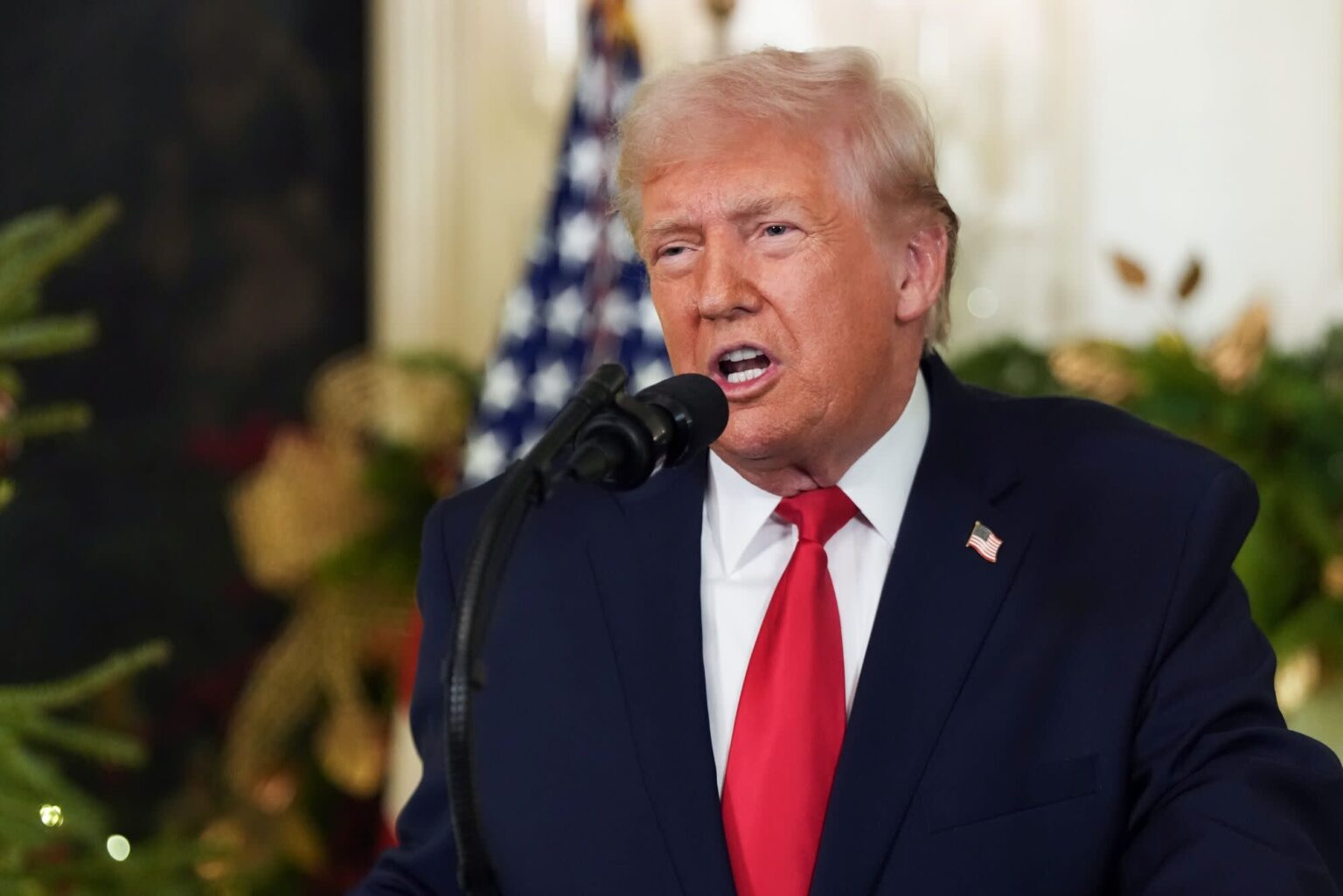
Donald Trump’s prime-time address from the White House should be understood primarily as an attempt to regain narrative control over the cost-of-living debate at a moment when it has once again become a central political vulnerability. At YourDailyAnalysis, we interpret the speech less as a progress report and more as a strategic communication effort aimed at shifting public attention from current price pressures toward promised near-term relief.
The most tangible element of the address was the announcement of a one-off $1,776 payment to active-duty service members and certain reservists. From our perspective, this measure serves multiple purposes: it delivers an immediate benefit to a politically salient group, injects short-term spending power during the holiday period, and allows the administration to demonstrate visible action. Its macroeconomic impact, however, remains limited, as it does not alter the underlying drivers of inflation or the structure of household expenses.
A second core pillar of the message centered on housing and interest rates, with Trump linking future affordability improvements to the appointment of a new Federal Reserve chair more inclined toward rate cuts and to what he described as aggressive housing reforms in 2026. Analysts at YourDailyAnalysis view this framing as politically intuitive but economically incomplete. Even if borrowing costs fall, the U.S. housing market remains constrained by long-standing supply shortages, suggesting that improvements in affordability are likely to be gradual rather than immediate.
The address took place against a backdrop of deteriorating public confidence in the administration’s economic stewardship. Declining approval ratings underscore a critical disconnect: disinflation in headline data has not translated into a widespread perception of improved living standards. At YourDailyAnalysis, we emphasize that voters tend to judge economic performance not by aggregate indices, but by everyday expenses – particularly housing, utilities, energy and healthcare.
Energy costs represent a particularly acute pressure point. Rising electricity demand, including from data centers, has translated into higher household bills. We see this channel as especially damaging to public sentiment, as utility costs are highly visible, recurring, and difficult for households to offset. In such an environment, claims of rapidly falling prices risk losing credibility, even if some goods categories stabilize.
Healthcare remains another structural challenge. Announced plans to overhaul subsidies or introduce new mechanisms for purchasing prescription drugs may shape expectations, but implementation risks are substantial. From the standpoint of YourDailyAnalysis, reforms in this area tend to operate with long lags, and without measurable reductions in out-of-pocket costs, they are unlikely to materially improve consumer confidence.
Trade policy, and tariffs in particular, emerged as one of the most internally inconsistent elements of the speech. While tariffs were presented as a source of revenue and a strategic tool, they are also widely associated with higher prices for imported goods. At Your Daily Analysis, we consider this dual narrative a potential vulnerability: should tariff-related price effects become more visible in retail channels in 2026, the administration’s current framing could face renewed scrutiny.
Taken together, the address reflects an effort to construct a transitional narrative – from acknowledging persistent economic strains to promising imminent relief through targeted payments, housing measures and future monetary shifts. The fundamental challenge, however, lies in the gap between political messaging and the slow-moving structural forces that shape the cost of living. Prices that matter most to households are driven by supply constraints and service-sector dynamics that cannot be quickly reversed.
The base-case outlook at YourDailyAnalysis for early 2026 is continued politicization of the cost-of-living issue, accompanied by an expansion of narrowly targeted measures designed to stabilize public sentiment. The risk of disappointment remains elevated if housing, energy and healthcare costs fail to show tangible improvement. Our conclusion is that the durability of the administration’s economic narrative will depend less on the scale of announced initiatives and more on whether households experience meaningful relief in their recurring monthly expenses.